Category: Smokers & Grills

  • Why Your Smoker Won't Hold Temperature (2026 Troubleshooting Guide)
    Why Your Smoker Won't Hold Temperature (2026 Troubleshooting Guide)

    You set the dial to 225°F, walk away for twenty minutes, and come back to a chamber reading 260°F, or worse, 190°F and dropping. If your smoker won't hold temperature, you are not the first person to fight with it, and the fix is almost never "buy a new grill." Most temperature problems trace back to a handful of causes, and most take less than ten minutes to check.

    This guide walks through the real reasons a smoker won't hold temperature, starting with the most common culprits and working down to the rare ones, so you can troubleshoot in the order that actually saves you time. It covers pellet grills first, since that's where most of these problems show up, then adds the specific fixes for offset, kamado, and electric smokers.

    The Short Answer

    If your smoker won't hold temperature, check these four things before anything else: the pellets (old, wet, or low-quality pellets cause more swings than any other single issue), the burn pot and drip tray (ash and grease buildup chokes airflow), the temperature probe (a greasy sensor reads wrong and confuses the whole system), and the weather (wind and cold pull heat out of the barrel faster than the auger can replace it). Fix those four and the vast majority of temperature problems go away. Everything else on this list, from auger jams to a failing fan, is rarer but still worth ruling out if the basics check out clean.

    How We Researched This

    When a smoker won't hold temperature, it's rarely one single thing, so this troubleshooting guide draws on manufacturer support documentation from Traeger and Pit Boss, independent technical writeups from pellet grill and BBQ specialists, and real owner reports from smoking forums, cross-checked against each other rather than relying on any single source. Where a fix applies only to pellet grills, or only to offset and kamako-style smokers, we call that out instead of treating every smoker the same.

    Bad or Wet Pellets Are the Number One Cause

    Traeger itself calls pellet quality the single most common reason a smoker won't hold temperature, and it lines up with what most experienced owners will tell you first. Low-density pellets, pellets that have absorbed moisture from humid storage, or a hopper full of sawdust and broken fines all burn unevenly. The auger feeds fuel at a steady rate assuming consistent pellets, and when that fuel varies in density, the fire varies with it, which shows up on your controller as a temperature that won't settle down.

    A quick test: a good pellet snaps cleanly and feels dense in your hand. A bad one crumbles or feels soft. If you store pellets in a garage or shed without an airtight container, especially somewhere humid, that alone can be the entire problem. Empty the hopper, vacuum out the dust sitting at the bottom of the auger tube, and load fresh, dry pellets before you troubleshoot anything else on this list. It's the cheapest fix on this page, and it solves the largest share of complaints.

    Ash and Grease Buildup Blocking Airflow

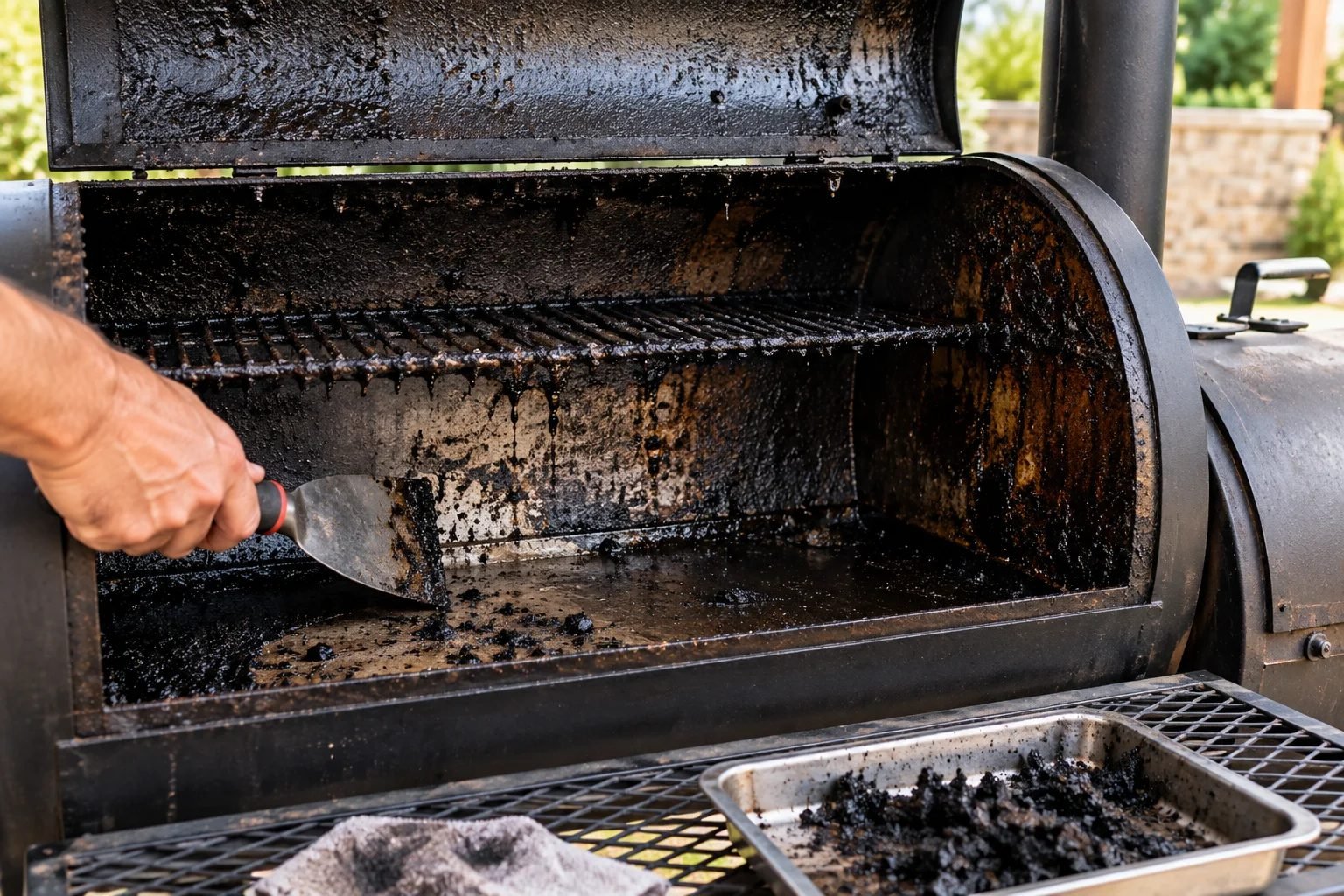
    A pellet smoker needs a clean burn pot to work correctly. Ash accumulates in the pot every time you cook, and once it builds up past a certain point, it smothers the hot rod's ability to ignite fresh pellets and blocks the airflow the fire needs. Traeger recommends cleaning the burn pot and vacuuming out ash roughly every 20 hours of cook time, and skipping that maintenance is a common reason a smoker that used to hold temperature just fine starts drifting.

    Ash and grease buildup inside a pellet smoker's burn pot, a common reason a smoker won't hold temperature

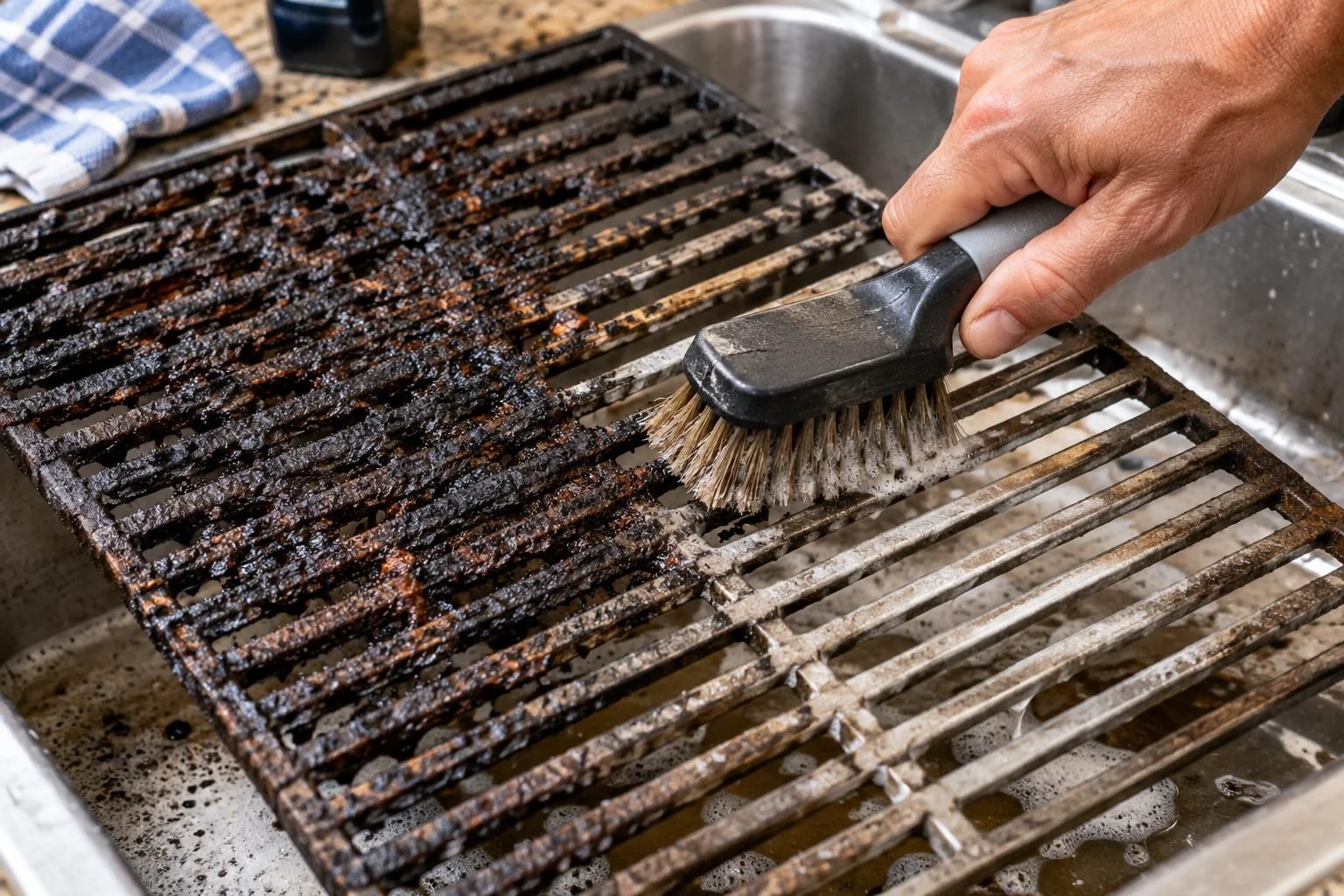
    A smoker won't hold temperature well if grease is the culprit either, which causes a related but separate problem. A drip tray or heat baffle caked in old grease disrupts how heat spreads through the cooking chamber, so one side of the grill runs hotter than the probe location while the average bounces around. Pull the drip tray and heat baffle out, scrape off the buildup, and check that neither piece is warped or sitting crooked, since a tilted baffle can dump grease straight onto the fire pot and cause exactly this kind of instability.

    A Dirty or Faulty Temperature Probe

    Every pellet grill controller makes its feeding decisions based on what the internal temperature probe reports, and if that probe is reading wrong, the whole system chases a number that doesn't match reality. A film of grease over the sensor insulates it slightly, so it reads a few degrees cooler than the actual chamber temperature. The controller sees that lower number, decides it needs more heat, and overfeeds pellets, which is exactly how you get a smoker that keeps overshooting and swinging even though nothing else is wrong.

    Wiping grease off a meat thermometer probe with a paper towel next to a smoker

    Traeger's own benchmark is useful here: a properly functioning probe should read within about 20°F of actual ambient air temperature when the grill is off and cool. Wipe the probe down with a damp cloth, check that it isn't bent or touching any other metal part of the grill, and confirm you removed any factory protective cap during assembly, since that's a surprisingly common oversight on grills fresh out of the box.

    Your P-Setting or Smoke Mode Is Fighting You

    Older, time-based pellet grill controllers use what's called a P-setting to control how often the auger feeds pellets. A lower P-setting shortens the pause between feed cycles, which delivers fuel faster and works well in cold weather, but it can also overshoot your target and widen the swing. A higher P-setting slows the feed rate and can undershoot instead, occasionally letting the fire nearly die out between cycles. If your smoker won't hold temperature consistently and you're on a time-based controller rather than a PID one, try nudging the P-setting one increment at a time based on whether the grill is running hot or cold before you assume something is broken.

    A smoker won't hold temperature as tightly on Smoke settings or Super Smoke modes, and that's by design, not a defect. These modes deliberately run a smoldering, less efficient burn to maximize visible smoke and flavor, which means a wider temperature range on that setting is expected behavior, not a defect. If you see steady swings on your regular cook setting but only on Super Smoke, that's the mode working as intended.

    Cold, Wind, and Rain

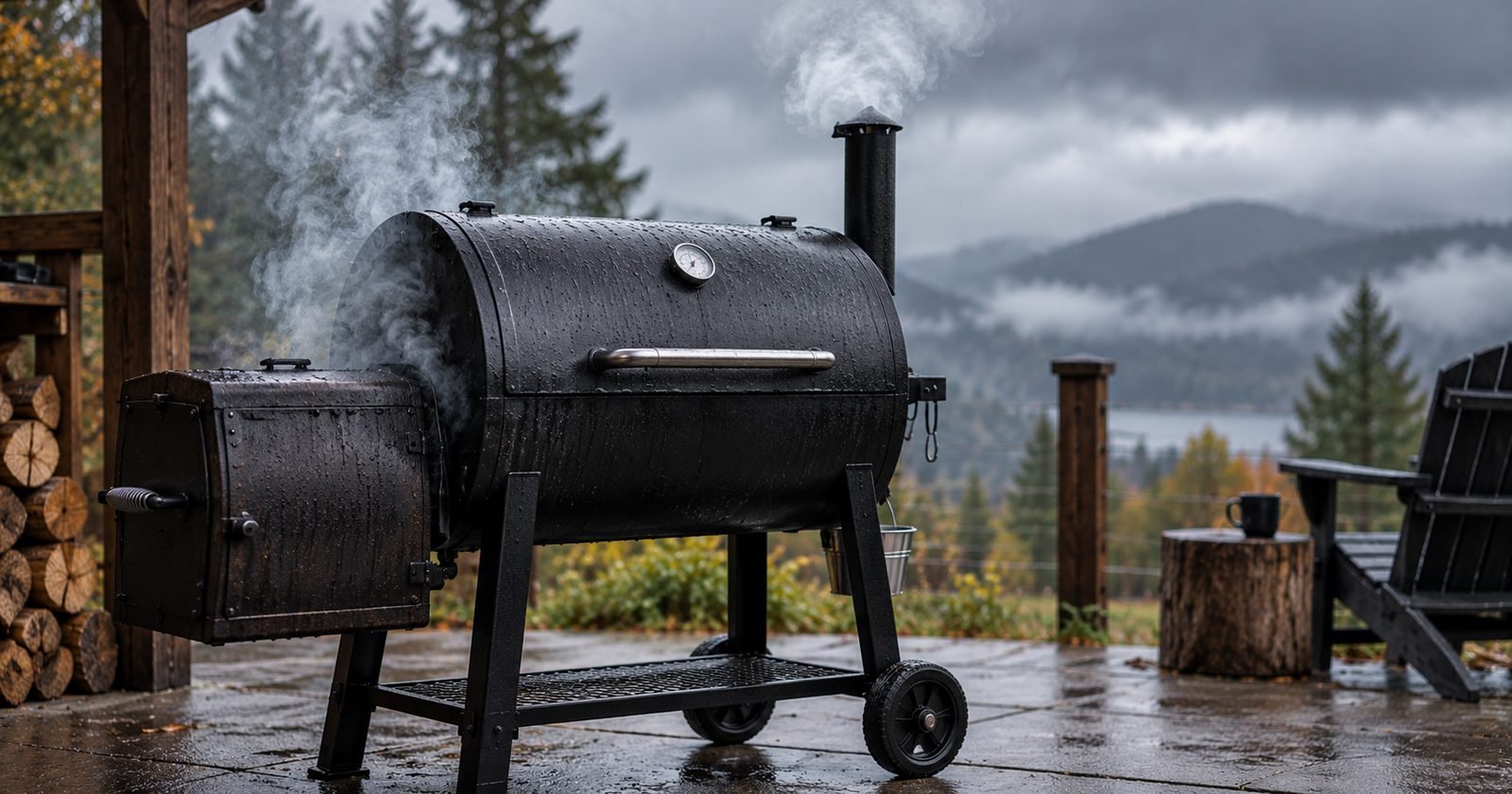
    A steel barrel loses heat fast in cold or windy conditions, and the auger has to work harder to keep up. Below about 35°F, most manufacturers recommend an insulation blanket, since it cuts down on radiant heat loss through the barrel walls and takes real strain off the feed system. Wind adds a second problem on top of the cold: a steady gust across the hopper vents or exhaust can pull heat out of the chamber directly and destabilize the fire, especially on grills without a fully enclosed hopper.

    Pellet smoker wrapped in an insulation blanket to help a smoker hold temperature in cold and windy weather

    If you cook outside through the winter, a windbreak, even something as simple as parking the grill against a fence or wall on the windward side, does more for stability than most people expect. Combine that with an insulation blanket and a slightly lower P-setting, and cold-weather swings usually come back in line with what you'd see on a mild day.

    Opening the Lid Too Often

    Every time you lift the lid to check on food, you vent the heat that built up inside the chamber, and the grill then has to burn extra pellets to climb back to your set point. Do that every fifteen minutes over a six-hour brisket cook, and you'll see a saw-tooth pattern on any temperature graph, dropping and spiking over and over, that looks like a hardware problem but is really just the lid. Use the meat probe and an app or a wireless meat thermometer instead of opening the lid to check, and the chamber temperature will hold far steadier on its own.

    Auger Jams and Empty Hoppers

    A jammed feed system is one of the simplest reasons a smoker won't hold temperature. An empty hopper is the obvious version of this problem, but a jammed auger causes the exact same symptom while looking like something more serious. Swollen pellets from moisture exposure, a broken chunk wedged in the feed tube, or debris that made its way into the hopper can all stop fuel delivery mid-cook, and once the fire starves, temperature crashes fast. If your smoker won't hold temperature and seems to be losing heat steadily rather than just drifting, check the hopper level first, then pull the auger tube and clear anything blocking it.

    Leaky Doors and Lids on Offset and Kamado Smokers

    On offset and kamado-style cookers, a smoker won't hold temperature mainly because of air you can't control, not fuel quality. A gap around the firebox door, the joint where the firebox meets the cook chamber, or an ill-fitting lid all let oxygen into the fire uncontrolled, and you can't manage temperature if you can't manage the oxygen feeding it. Sealing those gaps with high-temperature gasket tape or furnace cement noticeably tightens up an offset smoker's swing, sometimes down to a steady 8 to 10°F variance instead of 30°F or more.

    On charcoal cookers, the intake damper should do almost all your temperature control, with the exhaust vent left mostly open. Closing the intake too far starves the fire and creates the acrid, bitter smoke that ruins a cook, rather than actually holding a lower temperature. The Minion Method, a small pile of lit coals set on top of a larger bed of unlit ones, produces a much steadier multi-hour burn than lighting the entire charcoal basket at once.

    How Much Temperature Swing Is Actually Normal

    Not every fluctuation means a smoker won't hold temperature the way it should. Not every fluctuation means something is wrong, and knowing the baseline saves you from chasing a problem that doesn't exist. Traeger states that on a typical day with reasonable weather, a swing of up to about 25°F is normal for its grills. Independent testing backs that up for standard time-based controllers generally, while grills with a true PID controller tend to hold much tighter, often within 5 to 10°F of the set point, since PID systems continuously adjust auger feed and fan speed rather than cycling on a fixed pause.

    Controller TypeNormal SwingWhen to Worry
    Standard time-based (P-setting)±15 to 25°F40°F+ repeatedly, or no recovery after 10-15 minutes
    PID controller±5 to 10°F20°F+ swings on a mild day
    Smoke / Super Smoke mode (either type)Wider than normal cook mode by designGrill won't climb back to set temp once the mode is switched off
    Offset or kamado (well-sealed)±8 to 15°F30°F+ or constant damper adjustment needed

    If your smoker won't hold temperature within these general ranges after you've checked pellets, cleanliness, and probe condition, and the weather is reasonable, it's time to suspect a specific component rather than general maintenance.

    When It's Time to Call It a Hardware Problem

    If a smoker won't hold temperature even after you've ruled out pellets, cleanliness, the probe, weather, and lid discipline, a few remaining causes point to a failing part rather than routine upkeep.

    An induction fan that's obstructed by ash or grease can starve the fire of oxygen, and if the fan motor itself is dying, you'll typically hear it before you see the temperature problem. A cracked burn pot or a control board that's failed outright is rare, but it's the last thing to check precisely because it's uncommon. Manufacturers generally recommend working through every simpler cause first, since most support tickets that assumed a broken control board turned out to be dirty probes or bad pellets instead.

    If you've worked through this entire list on a grill still under warranty and nothing changes, that's the point to contact the manufacturer's support line rather than keep guessing. Bring notes on what you've already checked. It speeds up the diagnosis considerably and usually gets you past the generic troubleshooting script straight to a parts replacement if one is actually needed.

    For more on picking equipment that holds temperature well from the start, our guide to the best smokers for beginners breaks down which pellet, electric, and charcoal models are known for steady, predictable heat. And if inconsistent readings keep sending you back to the lid, pairing your smoker with a reliable meat thermometer makes it much easier to tell a real temperature problem from a probe placement issue in the meat itself.

    For the manufacturer's own troubleshooting steps, Traeger's support article on temperature swings covers grill-specific diagnostics in more depth, and PelHeat's independent breakdown of pellet grill temperature swings is a good technical comparison if you want to dig into PID versus time-based controllers further.

    Frequently Asked Questions

    Why does my Traeger temperature fluctuate so much?

    The most common causes are low-quality or wet pellets, ash buildup in the burn pot, a greasy temperature probe reading incorrectly, or cold and windy weather pulling heat out of the barrel. Check pellets and cleanliness first, since those two account for most fluctuation complaints.

    Is it normal for a pellet grill's temperature to swing?

    Yes, to a point. Traeger considers up to about 25 degrees Fahrenheit of swing normal on a standard time-based controller in reasonable weather. Grills with a PID controller typically hold tighter, closer to 5 to 10 degrees. Swings beyond that, or a grill that won't recover after 10 to 15 minutes, point to an actual problem worth troubleshooting.

    Why won't my smoker get hot enough to reach my set temperature?

    Check the hopper for an empty or jammed auger first, since a starved fire simply can't produce enough heat. After that, inspect the burn pot for heavy ash buildup blocking airflow, and confirm the temperature probe isn't reading falsely high because it's near a hot spot or flare-up, which would tell the controller it doesn't need more heat when it actually does.

    What P-setting should I use in cold weather?

    Lowering your P-setting by one or two increments feeds pellets faster, which helps offset the extra heat loss in cold weather. Combine that with an insulation blanket below about 35 degrees Fahrenheit for the biggest improvement, since the blanket addresses the root heat loss rather than just compensating for it with more fuel.

    How often should I clean my smoker to avoid temperature problems?

    Manufacturers generally recommend cleaning the burn pot and vacuuming out ash roughly every 20 hours of cook time, and checking the drip tray and heat baffle for grease buildup on a similar schedule. Skipping this maintenance is one of the most common reasons a smoker that used to hold temperature perfectly starts drifting months later.

  • Traeger vs Pit Boss: The Honest Comparison (2026)

    Traeger vs Pit Boss: The Honest Comparison (2026)

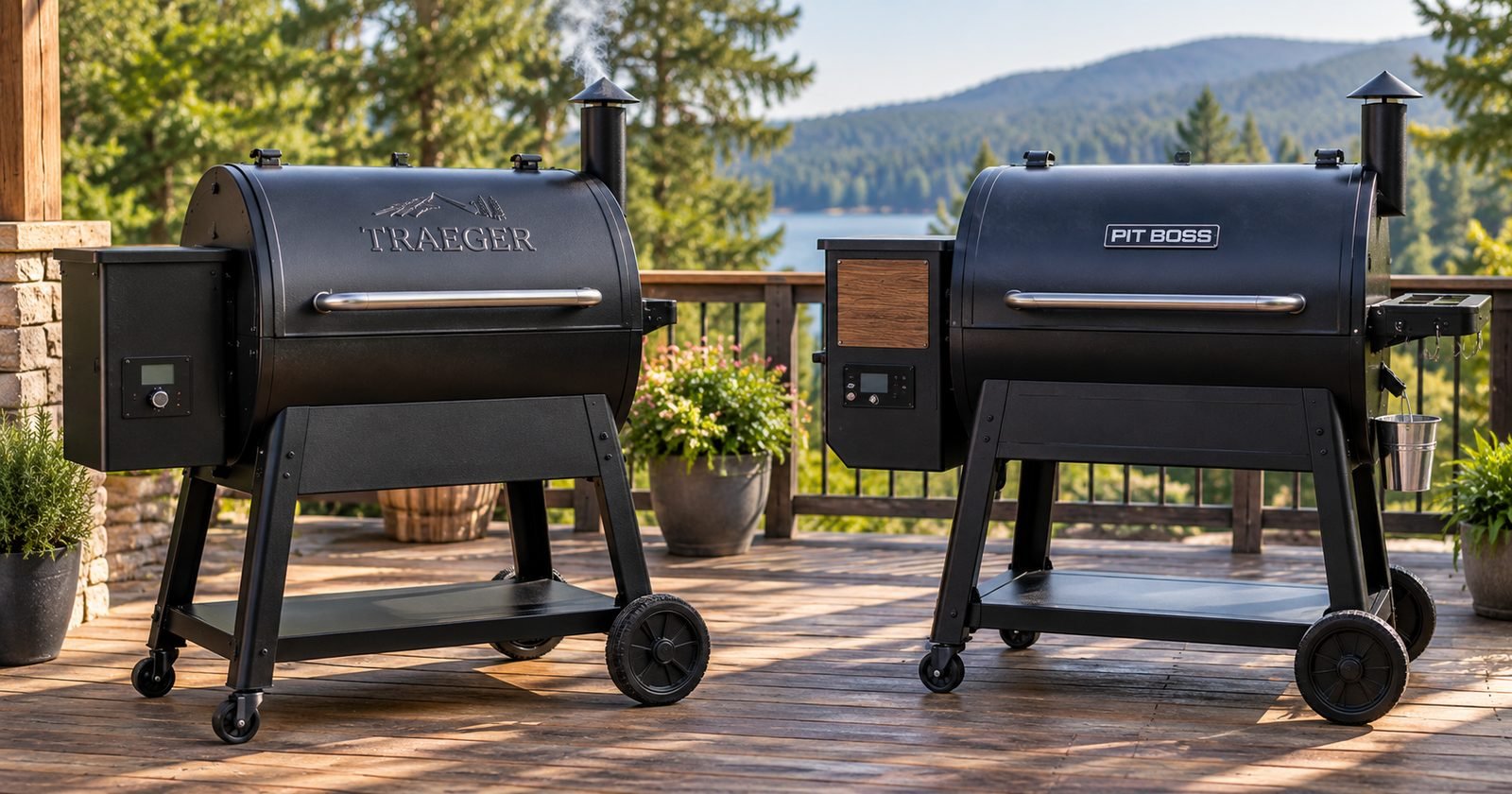
    Pellet grills took over backyard cooking because they do the hard part for you: feed wood pellets into a firepot, hold a set temperature, and let you walk away instead of babysitting coals. Two brands dominate that market, and if you have shopped for one in the last few years, you have almost certainly landed on a Traeger vs Pit Boss comparison at some point.

    Both brands sell grills that smoke, bake, roast, and grill in the same cooking space. Past that, they take different approaches to price, control precision, and what comes standard in the box. This guide breaks down the real Traeger vs Pit Boss differences across price, technology, build quality, and warranty, using current 2026 lineups from both brands, so you can figure out which one actually fits how you cook.

    How We Compared These Two Brands

    We built this Traeger vs Pit Boss comparison from each brand's own published 2026 specs and pricing pages, Traeger's model comparison tool and Pit Boss's full grill lineup among them, cross-checked against independent reviews and owner forums for real-world reliability notes rather than relying on marketing copy alone. Where a feature only shows up on certain tiers, like Traeger's Super Smoke Mode or Pit Boss's flame broiler plate, we call out which models actually have it instead of treating the brand as a single monolithic product.

    We also weighted price comparisons by cooking space and included accessories rather than sticker price alone, since a cheaper grill with less grate space or extra add-on costs is not automatically the better value.

    The Short Answer

    If you want the short version of Traeger vs Pit Boss before the details: Pit Boss wins on price and included accessories, while Traeger wins on temperature precision and app polish. A Pit Boss Navigator or Sportsman gets you a similarly sized grill for less money, plus extras like side shelves that Traeger charges separately for. A Traeger Woodridge or Ironwood holds a set temperature more tightly and pairs with an app that most reviewers rate as the more reliable of the two.

    Neither brand makes a bad grill at this point; both have been through several hardware generations and fixed most of the early reliability complaints. The real decision is about what you are optimizing for: lower cost per square inch of cooking space, or tighter control and a smoother digital experience.

    Traeger's Current Lineup and Technology

    On the Traeger side of this Traeger vs Pit Boss matchup, the 2026 lineup runs from the entry-level Westwood up through the flagship Ironwood XL, with the mid-tier Woodridge and Timberline series in between. The Westwood starts at $699.99 with an 18-pound hopper and 653 square inches of cooking space. Step up to the Woodridge at $899.99, and you get a larger 24-pound hopper, 860 square inches of grate space, and a downdraft exhaust system that pulls smoke down through the food instead of venting it straight out the back.

    The Timberline and Ironwood series sit above that, adding extra insulation, a Super Smoke Mode that runs the auger in short pulses at lower temperatures to push more smoke flavor into the meat, and additional cook-monitoring stations for probes. Every current Traeger, from Westwood up, connects to the WiFire app for remote temperature monitoring and alerts. All of it runs on 16-gauge steel construction and comes with a 10-year limited warranty, which is longer than what Pit Boss offers.

    Pit Boss's Current Lineup and Technology

    On the other side of this Traeger vs Pit Boss matchup, Pit Boss spreads its lineup across more series than Traeger does. The Carbon series is the true budget entry point at $349.99 to $379.99, with basic digital controls and a 180 to 500°F range. Above that, the FB2 series ($399.99 to $599.99) and Navigator series ($699.99 to $999.99) add 5°F control increments and WiFi/Bluetooth connectivity through the Smoke IT app. The Navigator 1600M tops out the mainstream range with 1,329-plus square inches of cooking space for under $1,000.

    The Sportsman series ($749.99 to $849.99) is worth calling out: it comes standard with front and side shelves that Traeger sells as a separate accessory on comparable models. Pit Boss also sells retailer-exclusive Pro Series and DX Series grills with cast-iron cooking surfaces at select big-box stores. The lineup uses heavy-gauge steel, and Pit Boss backs its grills with a 5-year warranty.

    Temperature Control and Smoke Quality

    This is where most of the real Traeger vs Pit Boss gap shows up in actual cooking. Traeger's PID controllers hold a set temperature in 5°F increments across the board and are widely reported to swing less around the target than Pit Boss's older analog-style controllers, which adjust in wider 25 to 50°F steps on the budget Carbon models. Pit Boss's newer Navigator, Sportsman, and FB2 lines closed most of that gap by moving to 5°F digital increments as well, so the difference is now mainly a Traeger-vs-budget-Pit-Boss gap rather than a Traeger-vs-every-Pit-Boss gap.

    Smoke output follows a similar pattern. Traeger's Super Smoke Mode on Timberline and Ironwood models deliberately runs cooler and pulses the auger to generate more visible smoke, which matters if you are chasing a heavier smoke ring and bark on brisket or ribs. Pit Boss doesn't market an equivalent mode by name, but reviewers consistently describe its smoke flavor as comparable at normal cooking temperatures, with the gap narrowing further when you run low and slow rather than high-heat grilling.

    Apps and WiFi Connectivity

    App quality is one more angle on Traeger vs Pit Boss worth weighing on its own. Both brands now build WiFi into nearly every model above their cheapest tier. Traeger's WiFire app lets you monitor and adjust grill temperature, track probe readings, and browse guided recipes from your phone, and it is generally the more polished of the two apps in day-to-day reviews. Pit Boss's Smoke IT app covers the same basics: remote temperature monitoring, probe alerts, and grill control, but multiple reviewers describe it as functional rather than refined, with occasional lag reconnecting after a dropped WiFi signal.

    Neither app is a dealbreaker on its own. If remote monitoring and a smooth app experience matter more to you than saving money, that tips toward Traeger. If you mainly want basic phone alerts and don't mind an app that is a little rougher around the edges, Pit Boss's connectivity gets the job done for less.

    Build Quality and Warranty

    Build quality is a closer call in the Traeger vs Pit Boss debate than price or searing. Traeger builds its current grills from 16-gauge steel and backs them with a 10-year limited warranty, the longer of the two brands' coverage terms. Pit Boss uses heavy-gauge steel as well and backs its grills with a 5-year warranty. In practice, both brands have had user-reported issues with paint, hopper fires, and auger jams on specific models over the years, so warranty length matters more as a hedge than as proof one brand never breaks.

    If a grill living outside through harsh winters or coastal salt air is a concern, the extra five years of coverage on Traeger's warranty is a real, quantifiable advantage. For grills that live under a covered patio and get moderate use, the practical difference is smaller than the number suggests.

    Searing and Direct Flame Cooking

    Here is a spot where the Traeger vs Pit Boss comparison tips clearly toward one brand: most Pit Boss models include a flame broiler slide plate, a metal panel you slide open to expose the food directly to the firepot's flame for searing steaks or getting a hard char on vegetables. Traeger's mainstream lineup doesn't include an equivalent direct-flame feature; you get excellent smoking and roasting performance, but true direct-flame searing usually means finishing on a separate cast-iron pan or using a dedicated searing accessory.

    Pit Boss flame broiler slide plate open over the firepot for direct-flame searing

    If steaks and quick high-heat cooks are a regular part of how you plan to use the grill, that flame broiler plate is a genuine reason to lean Pit Boss, independent of price.

    Pellet Consumption and Cost to Run

    Sticker price is only part of the cost of owning a Traeger vs. a Pit Boss. Both brands burn roughly 1 to 3 pounds of pellets per hour depending on set temperature, with low-and-slow smoking at 225°F using less fuel than high-heat grilling above 400°F. At an average $1.50 to $2 per pound for quality hardwood pellets, a typical 8-hour brisket smoke costs somewhere between $12 and $30 in pellets on either brand, so fuel cost is not a meaningful differentiator between them.

    The two brands diverge slightly in hopper capacity and how often you need to refill mid-cook. Traeger's Woodridge and larger models hold up to 24 pounds, while several Pit Boss models hold up to 30 pounds, which means fewer refills on long overnight cooks. Both brands also sell their own branded pellets, but neither locks you into using only that brand's pellets in the hopper.

    Traeger vs Pit Boss: Side-by-Side Comparison

    Here is the full Traeger vs Pit Boss breakdown in one place, comparing entry-level and mid-tier models from each brand.

    TraegerPit Boss
    Starting price$699.99 (Westwood)$349.99 (Carbon)
    Mid-tier price$899.99 (Woodridge)$699.99–$999.99 (Navigator)
    Hopper capacity18–24 lbsVaries by series, up to 30 lbs
    Temperature controlPID, 5°F increments across the line5°F on Navigator/Sportsman/FB2, wider steps on Carbon
    AppWiFire — widely rated more polishedSmoke IT — functional, less refined
    Direct-flame searingNot standardFlame broiler slide plate on most models
    Included shelvesFront shelf often sold separatelyStandard on Sportsman series
    Warranty10-year limited5-year
    Construction16-gauge steelHeavy-gauge steel

    If you want a concrete matchup rather than lineup-wide generalities, compare the Traeger Ironwood 885 against the Pit Boss Navigator 1600M. Both land in similar cooking-space territory, both connect to an app, and both run digital PID-style control. The Ironwood costs more but adds Super Smoke Mode, better insulation for cold-weather cooking, and Traeger's 10-year warranty. The Navigator 1600M costs less, gives you slightly more raw grate space, and includes the flame broiler plate for searing that the Ironwood doesn't have. Neither is the objectively "better" grill; they are built around different priorities at different price points.

    Which One Should You Buy?

    Boiling the whole Traeger vs Pit Boss decision down to your situation: choose Pit Boss if you want the most cooking space and accessories per dollar, you plan to sear steaks directly over flame, or you are buying your first pellet grill and don't want to spend $900-plus to find out if you like the format. The Sportsman and Navigator series, in particular, give you WiFi control, a large cooking surface, and included shelves at a price Traeger doesn't match at the same size.

    Choose Traeger if temperature consistency and a smooth app experience matter more than upfront cost, you smoke low and slow often enough that Super Smoke Mode's extra flavor is worth paying for, or you want the longer 10-year warranty on a grill that will sit outside year-round. If you are just getting started and want a broader look at what to consider before buying any pellet smoker, our guide to the best smokers for beginners covers pellet, electric, and charcoal options side by side.

    Whichever brand you land on, pair it with an accurate meat thermometer rather than trusting the grill's built-in lid gauge. Both Traeger and Pit Boss controllers read the ambient chamber temperature, not the internal temperature of your food, so a separate probe is still the only reliable way to know when a brisket or a chicken breast is actually done.

    Frequently Asked Questions

    Which is better, Traeger or Pit Boss?

    Neither brand is better across the board. Pit Boss generally wins on price, included accessories, and direct-flame searing. Traeger generally wins on temperature control precision, app polish, and warranty length. The right pick depends on which of those you value more.

    Is Pit Boss as good as Traeger?

    On the newer Navigator, Sportsman, and FB2 lines, Pit Boss closes most of the temperature-control gap that used to separate the two brands, since those models now use 5°F digital increments similar to Traeger. The main remaining gaps are app polish and warranty length, where Traeger still leads.

    Why is Traeger more expensive than Pit Boss?

    Traeger's pricing reflects its 10-year warranty, PID temperature controllers across the full lineup, and features like Super Smoke Mode and downdraft exhaust on its mid-tier and premium models. Pit Boss keeps costs down by using simpler controllers on its budget Carbon series and by not including a searing-specific mode, though its flame broiler plate offsets that for direct-flame cooking.

    Can you sear steaks on a Traeger or Pit Boss?

    Both can get a grill grate hot enough for a decent sear, but Pit Boss's flame broiler slide plate gives food direct flame contact for a harder char, which most Traeger models don't offer. Traeger owners who want a true sear typically finish steaks in a cast-iron pan or with a separate searing accessory.

    Do Traeger and Pit Boss use the same wood pellets?

    Yes. Both brands' grills burn standard 100 percent hardwood pellets, and pellets from other brands work in either grill's hopper as long as they are dry and properly sized. Each brand also sells its own branded pellet lineup, but you are not locked into using only that brand's pellets.

  • Best Smokers for Beginners in 2026: 5 Picks That Won't Ruin Your First Brisket
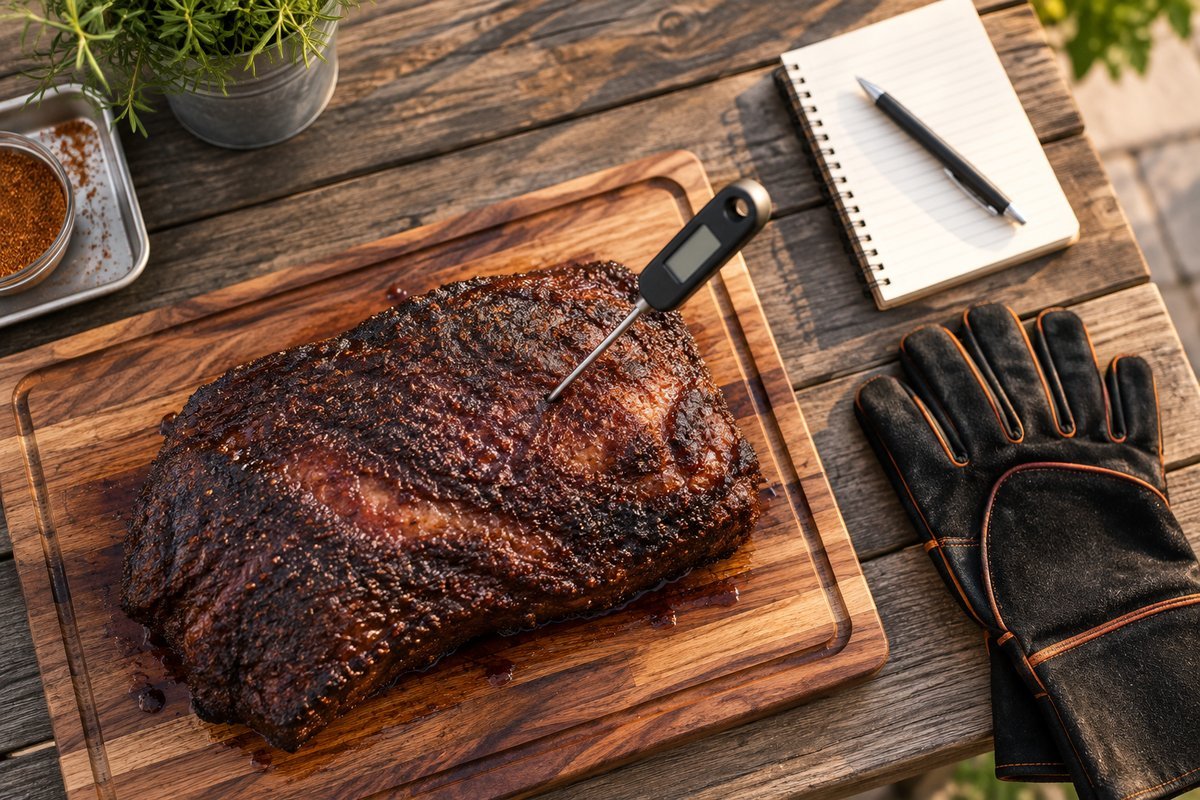
    Best Smokers for Beginners in 2026: 5 Picks That Won't Ruin Your First Brisket

    Picking the best smoker for beginners is less about finding the "best" smoker overall and more about finding one that won't make you want to quit after your first brisket turns out dry. Pitmasters who've been at this for years can baby an offset smoker through a six-hour fire management session. Most people starting out just want something that holds a steady temperature, doesn't need constant attention, and produces food worth eating on the first try.

    That's the filter we used here. Every pick below is either a pellet grill, an electric smoker, or a beginner-friendly charcoal unit, because those three categories forgive a new cook's mistakes. Offset smokers and stick burners are left out on purpose. They're excellent once you know what you're doing, and miserable to learn on.

    The best smoker for beginners: our top picks at a glance

    SmokerTypeTypical priceBest for
    Weber Searwood 600Pellet~$800-900Best overall beginner pick
    Pit Boss 850 DXPellet~$450-550Best budget pellet grill
    Masterbuilt 30" Digital ElectricElectric~$300-350Best electric smoker
    Weber Smokey Mountain 22"Charcoal~$400-450Best charcoal smoker for beginners
    Camp Chef Woodwind Pro 24"Pellet~$700-800Best if you'll want more control later

    Prices move around by season and retailer, so treat these as ballpark figures rather than a quote you can hold anyone to.

    What actually matters when you're just starting out

    Skip past the marketing copy. The best smoker for beginners really only needs to do four things well.

    • Temperature stability. A smoker that swings 40 degrees in either direction turns every cook into a guessing game. Digital controllers on pellet and electric smokers exist specifically to remove this variable.
    • A reasonable learning curve. You should be able to read the manual once and cook the same day, not spend a weekend studying fire management theory.
    • Enough cooking space for a full meal. A rack that fits two racks of ribs is fine for one person; it's not enough once you're cooking for a group.
    • Parts you can actually get. Cheaper off-brand smokers sometimes use proprietary probes or ignition parts that are hard to replace when they wear out.

    None of this means you need to spend a lot of money. It means the money you do spend on the best smoker for beginners should go toward temperature control first and everything else second.

    Digital controller on the best smoker for beginners set to 225 degrees
    The digital controller lets you set and hold an exact temperature.

    Best overall: Weber Searwood 600

    The Weber Searwood 600 is a pellet grill, which means it runs on an auger that feeds wood pellets into a firepot and a controller that adjusts the feed rate to hold your set temperature. For a beginner, that's the whole appeal: you set 225°F, walk away, and the grill does the babysitting.

    As one of the best smoker picks for beginners on this list, the Searwood comes with 648 square inches of cooking space, enough for a full packer brisket plus a couple of racks of ribs. Reviewers consistently point out that the controller heats up fast and holds temperature reliably, even in cooler weather, and that grease and ash management is simpler than on many competing pellet grills. That last point matters more than it sounds. A smoker that's a pain to clean gets used less.

    It costs more than the budget pellet option below, and if you're not sure smoking is going to become a regular hobby, that's a real consideration. But if you already know you'll use it every weekend, the extra reliability tends to pay for itself in fewer ruined cooks.

    Best budget pellet grill: Pit Boss 850 DX

    The Pit Boss 850 DX was built for first-time buyers who don't want to spend $800 only to find out they don't like smoking meat. It has a 21-pound pellet hopper, a 180°F to 500°F range, and a probe-controlled keep-warm mode that automatically drops to 180°F once your food hits its target temperature. That's a safety feature you don't usually see at this price, and it means a slightly late dinner doesn't turn into an overcooked one.

    It won't feel as solidly built as the Searwood, and the WiFi app control on Pit Boss grills is a mixed bag depending on which model and firmware you land on. But as a way to find out whether you actually want to get into this hobby before spending real money, it's hard to beat.

    Best electric smoker: Masterbuilt 30-Inch Digital Electric

    Electric smokers are the easiest category to learn, and Masterbuilt's 30-inch digital model shows up on nearly every beginner list for a reason. It has 710 square inches across four chrome-coated racks, push-button digital controls, and a side wood chip loader that lets you add smoke flavor without opening the main door and losing your heat.

    The tradeoff with electric smokers is flavor depth. You get real smoke from the wood chips, but you won't get the same bark and smoke ring you'd see from a stick burner or even a pellet grill running a heavier pellet blend. For a first smoker, most people find that tradeoff completely worth it. You'll actually finish cooks instead of fighting the equipment.

    Best charcoal smoker for beginners: Weber Smokey Mountain 22-Inch

    If you want to learn on charcoal because you like the idea of a more hands-on process, the Weber Smokey Mountain is the one to start with. It's a water smoker, meaning a pan of water sits between the coals and the food and acts as a heat buffer, which makes it much more forgiving than a bare charcoal grill.

    The 22-inch model gives you 726 square inches across two grates, and the porcelain-enameled steel body holds a steady 225-275°F for 12 or more hours on a single load of charcoal once you've dialed in your vents. That vent-dialing is the actual learning curve here. It'll take you two or three cooks to get a feel for it, and after that it becomes second nature.

    If 22 inches feels like too much smoker for your first purchase, Weber also sells an 18-inch version that's easier to store and still plenty capable for cooking for a family.

    Best if you'll want more control later: Camp Chef Woodwind Pro 24"

    The Woodwind Pro sits a step above the other pellet grills here. It's still simple to operate day one, with digital controls that let you dial in an exact temperature, plus an ash cleanout system that makes maintenance genuinely easy instead of just marketed as easy. What sets it apart is the sear box attachment available for the line, which adds direct-flame, high-heat searing that most pellet grills can't do at all.

    Compared with the other best smoker for beginners picks here, you probably won't touch that sear box in your first month of ownership. But if you can already tell you're going to get serious about this, buying a grill with room to grow into is a reasonable way to avoid replacing your smoker a year in.

    Pellet, electric, charcoal, or propane: which type should a beginner buy

    If you're not set on a type yet and still weighing what the best smoker for beginners actually looks like, here's the honest breakdown.

    TypeLearning curveFlavorHands-on time
    PelletLowGoodVery low
    ElectricVery lowFairVery low
    Charcoal (water smoker)ModerateGreatModerate
    PropaneLowFairLow

    Pellet grills are the closest thing to a set-it-and-forget-it smoker. The controller manages the fire, so your job is mostly loading the hopper and putting food on the grate. Most people who ask "what smoker should I buy" and don't have a strong opinion end up happiest with a pellet grill.

    Electric smokers go a step further in simplicity, but you trade a bit of flavor depth for it. They're a strong choice if your main goal is consistent results with minimal fuss, or if local regulations restrict open flame or wood/charcoal smokers (check your city or HOA rules, since this varies a lot by location).

    Charcoal water smokers take a little more attention to vents and fuel, but reward you with noticeably better smoke flavor and bark. If you like the process as much as the result, this is the category to pick.

    Propane smokers are worth a mention mainly for people who already have propane tanks around from a gas grill and want the lowest possible learning curve. They're capable, but they're not usually anyone's first choice when starting from scratch.

    Checking a smoked brisket with a thermometer, a step for anyone learning the best smoker for beginners
    Always check doneness by internal temperature, not by the clock.

    Mistakes beginners make with a new smoker

    Even the best smoker for beginners will not save you from a few things that trip up almost everyone in the first month.

    • Opening the lid too often. Every time you check on the food, you lose heat and add cook time. Trust your thermometer, not your eyes.
    • Cooking by time instead of temperature. A "6-hour brisket" is a guideline, not a rule. Pull meat based on internal temperature, not the clock.
    • Skipping the seasoning burn. New smokers, especially charcoal and electric ones, usually need an empty seasoning burn before the first real cook to clear out manufacturing residue.
    • Not using a separate meat thermometer. Built-in probes on pellet and electric smokers are convenient but not always accurate. Check out our guide to the best meat thermometers for grilling and smoking to find a reliable backup.

    Frequently asked questions

    What's the easiest smoker to use for a complete beginner?

    An electric smoker like the Masterbuilt 30-Inch Digital or a pellet grill like the Pit Boss 850 DX. Both use digital controls to manage temperature automatically, so you don't have to learn to manage fire.

    Do I need to spend a lot of money on my first smoker?

    No. Among the best smoker options for beginners, a solid entry-level electric or pellet smoker in the $300-500 range will produce good results. Spending more mainly buys you better build quality, more cooking space, and extra features like WiFi monitoring, not dramatically better food.

    Is a pellet grill or an electric smoker better for beginners?

    Both are beginner-friendly. Pellet grills give you slightly better flavor and can also grill at higher temperatures, while electric smokers are usually cheaper and even simpler to operate. If you want one appliance that also handles weeknight grilling, go pellet. If you want the simplest possible learning curve, go electric.

    How long does it take to learn to use a smoker?

    On a pellet or electric smoker, you can get usable results on your very first cook. On a charcoal water smoker, expect two or three cooks before you've got a feel for managing the vents and fuel.

    Bottom line: the best smoker for beginners

    If you want the simplest possible path to good barbecue, get an electric or pellet smoker and stop overthinking it. The Masterbuilt 30-Inch Digital Electric and the Pit Boss 850 DX are both inexpensive enough to be low-risk first purchases. If you already know you'll stick with this hobby, the Weber Searwood 600 is worth the extra upfront cost. And if you like a more hands-on process and don't mind a slightly longer learning curve, the Weber Smokey Mountain 22-Inch will get you there with real charcoal flavor.