
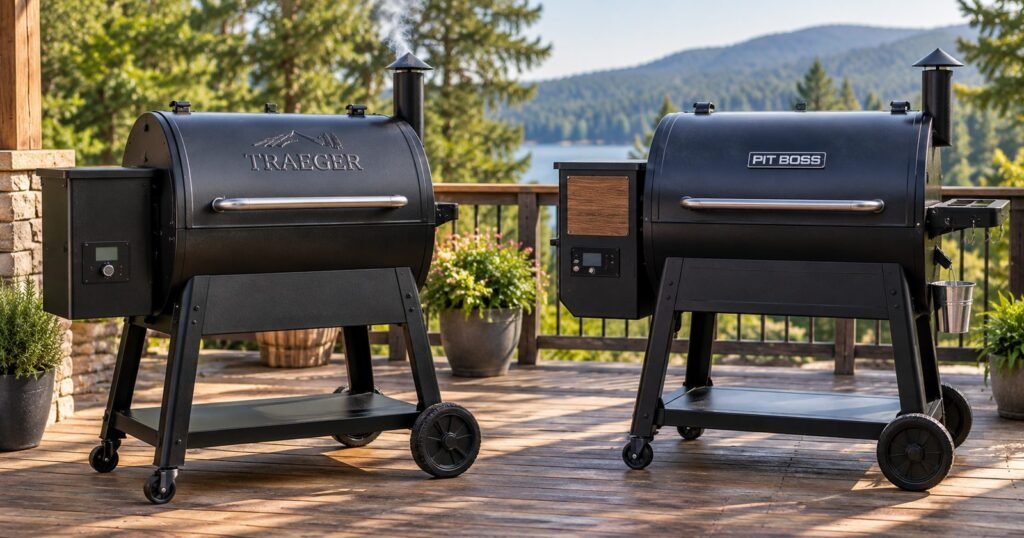
Pellet grills took over backyard cooking because they do the hard part for you: feed wood pellets into a firepot (the small cup where the pellets burn), hold a set temperature, and let you walk away instead of babysitting coals. Two brands dominate that market, and if you have shopped for one in the last few years, you have almost certainly landed on a Traeger vs Pit Boss comparison at some point.
Both brands sell grills that smoke, bake, roast, and grill in the same cooking space. Past that, they take different approaches to price, control precision, and what comes standard in the box. This guide breaks down the Traeger vs Pit Boss differences across price, technology, build quality, and warranty, using current 2026 lineups from both brands, so you can figure out which one fits how you cook.
Table of Contents
How We Compared These Two Brands
We built this Traeger vs Pit Boss comparison from each brand's own published 2026 specs and pricing pages, Traeger's model comparison tool and Pit Boss's full grill lineup among them. We cross-checked them against independent reviews and owner forums for real-world reliability notes rather than relying on marketing copy alone. Where a feature only shows up on certain tiers, like Traeger's Super Smoke Mode or Pit Boss's flame broiler plate, we call out which models have it instead of treating the brand as a single monolithic product.
We also weighted price comparisons by cooking space and included accessories rather than sticker price alone, since a cheaper grill with less grate space or extra add-on costs is not automatically the better value.
The Short Answer
If you want the short version of Traeger vs Pit Boss before the details: Pit Boss wins on price and included accessories, while Traeger wins on temperature precision and app polish. A Pit Boss Navigator or Sportsman gets you a similarly sized grill for less money, plus extras like side shelves that Traeger charges separately for. A Traeger Woodridge or Ironwood holds a set temperature more tightly and pairs with an app that most reviewers rate as the more reliable of the two.
Neither brand makes a bad grill at this point. Both have been through several hardware generations and fixed most of the early reliability complaints. The decision comes down to what you are optimizing for: lower cost per square inch of cooking space, or tighter control and a smoother digital experience.
Traeger's Current Lineup and Technology
Traeger's 2026 lineup runs from the entry-level Westwood up through the flagship Ironwood XL, with the mid-tier Woodridge and Timberline series in between. The Westwood starts at $699.99 with an 18-pound hopper (the bin that holds the pellets) and 653 square inches of cooking space. Step up to the Woodridge at $899.99, and you get a larger 24-pound hopper, 860 square inches of grate space, and a downdraft exhaust system that pulls smoke down through the food instead of venting it straight out the back.
The Timberline and Ironwood series sit above that, adding extra insulation and a Super Smoke Mode that runs the auger (the screw that feeds pellets to the fire) in short pulses at lower temperatures to push more smoke flavor into the meat. They also add more probe stations for monitoring the cook. Every current Traeger, from Westwood up, connects to the WiFire app for remote temperature monitoring and alerts. All of it runs on 16-gauge steel construction and comes with a 10-year limited warranty, which is longer than what Pit Boss offers.
Pit Boss's Current Lineup and Technology
Pit Boss spreads its lineup across more series than Traeger does. The Carbon series is the true budget entry point at $349.99 to $379.99, with basic digital controls and a 180 to 500°F range. Above that, the FB2 series ($399.99 to $599.99) and Navigator series ($699.99 to $999.99) add 5°F control increments and WiFi/Bluetooth connectivity through the Smoke IT app. The Navigator 1600M tops out the mainstream range with 1,329-plus square inches of cooking space for under $1,000.
The Sportsman series ($749.99 to $849.99) is worth calling out: it comes standard with front and side shelves that Traeger sells as a separate accessory on comparable models. Pit Boss also sells retailer-exclusive Pro Series and DX Series grills with cast-iron cooking surfaces at select big-box stores. The lineup uses heavy-gauge steel, and Pit Boss backs its grills with a 5-year warranty.
Temperature Control and Smoke Quality
Most of the gap between the two brands shows up during cooking. Traeger's PID controllers (smart controllers that keep adjusting the pellet feed to hold the set temperature) hold a set temperature in 5°F increments across the board. They are widely reported to swing less around the target than Pit Boss's older analog-style controllers, which adjust in wider 25 to 50°F steps on the budget Carbon models. Pit Boss's newer Navigator, Sportsman, and FB2 lines closed most of that gap by moving to 5°F digital increments as well, so the difference is now mainly a Traeger-vs-budget-Pit-Boss gap rather than a Traeger-vs-every-Pit-Boss gap.
Smoke output follows a similar pattern. Traeger's Super Smoke Mode on Timberline and Ironwood models deliberately runs cooler and pulses the auger to generate more visible smoke. That matters if you are chasing a heavier smoke ring and bark (the dark, crusty outer layer) on brisket or ribs. Pit Boss doesn't market an equivalent mode by name, but reviewers consistently describe its smoke flavor as comparable at normal cooking temperatures, with the gap narrowing further when you run low and slow rather than high-heat grilling.
Apps and WiFi Connectivity
App quality is worth weighing on its own. Both brands now build WiFi into nearly every model above their cheapest tier. Traeger's WiFire app lets you monitor and adjust grill temperature, track probe readings, and browse guided recipes from your phone, and it is generally the more polished of the two apps in day-to-day reviews. Pit Boss's Smoke IT app covers the same basics: remote temperature monitoring, probe alerts, and grill control, but multiple reviewers describe it as functional rather than refined, with occasional lag reconnecting after a dropped WiFi signal.
Neither app is a dealbreaker on its own. If remote monitoring and a smooth app experience matter more to you than saving money, that tips toward Traeger. If you mainly want basic phone alerts and don't mind an app that is a little rougher around the edges, Pit Boss's connectivity gets the job done for less.
Build Quality and Warranty
Build quality is a closer call than price or searing. Traeger builds its current grills from 16-gauge steel and backs them with a 10-year limited warranty, the longer of the two brands' coverage terms. Pit Boss uses heavy-gauge steel as well and backs its grills with a 5-year warranty. In practice, both brands have had user-reported issues with paint, hopper fires, and auger jams on specific models over the years, so warranty length matters more as a hedge than as proof one brand never breaks.
If a grill living outside through harsh winters or coastal salt air is a concern, the extra five years of coverage on Traeger's warranty is a clear advantage. For grills that live under a covered patio and get moderate use, the practical difference is smaller than the number suggests.
Searing and Direct Flame Cooking
Searing is where the comparison tips clearly toward one brand: most Pit Boss models include a flame broiler slide plate, a metal panel you slide open to expose the food directly to the firepot's flame for searing steaks or getting a hard char on vegetables. Traeger's mainstream lineup doesn't include an equivalent direct-flame feature. You get excellent smoking and roasting performance, but true direct-flame searing usually means finishing on a separate cast-iron pan or using a dedicated searing accessory.
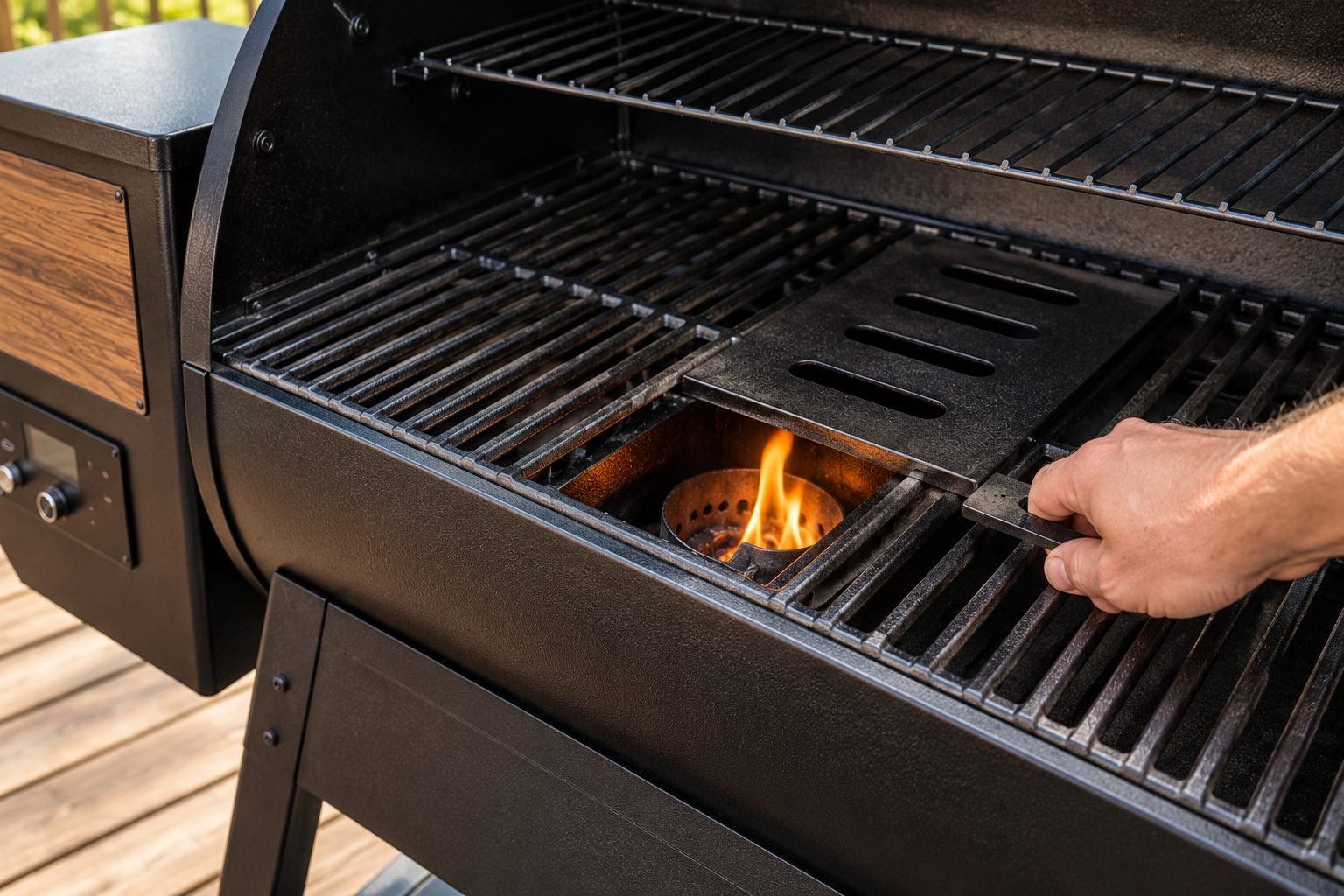
If steaks and quick high-heat cooks are a regular part of how you plan to use the grill, that flame broiler plate is a good reason to lean Pit Boss, independent of price.
Pellet Consumption and Cost to Run
Sticker price is only part of the cost of owning either grill. Both brands burn roughly 1 to 3 pounds of pellets per hour depending on set temperature, with low-and-slow smoking at 225°F using less fuel than high-heat grilling above 400°F. At an average $1.50 to $2 per pound for quality hardwood pellets, a typical 8-hour brisket smoke costs somewhere between $12 and $30 in pellets on either brand, so fuel cost is not a meaningful differentiator between them.
The two brands diverge slightly in hopper capacity and how often you need to refill mid-cook. Traeger's Woodridge and larger models hold up to 24 pounds, while several Pit Boss models hold up to 30 pounds, which means fewer refills on long overnight cooks. Both brands also sell their own branded pellets, but neither locks you into using only that brand's pellets in the hopper.
Traeger vs Pit Boss: Side-by-Side Comparison
Here is the full breakdown in one place, comparing entry-level and mid-tier models from each brand.
| Traeger | Pit Boss | |
|---|---|---|
| Starting price | $699.99 (Westwood) | $349.99 (Carbon) |
| Mid-tier price | $899.99 (Woodridge) | $699.99 to $999.99 (Navigator) |
| Hopper capacity | 18 to 24 lbs | Varies by series, up to 30 lbs |
| Temperature control | PID, 5°F increments across the line | 5°F on Navigator/Sportsman/FB2, wider steps on Carbon |
| App | WiFire: widely rated more polished | Smoke IT: functional, less refined |
| Direct-flame searing | Not standard | Flame broiler slide plate on most models |
| Included shelves | Front shelf often sold separately | Standard on Sportsman series |
| Warranty | 10-year limited | 5-year |
| Construction | 16-gauge steel | Heavy-gauge steel |
If you want a concrete matchup rather than lineup-wide generalities, compare the Traeger Ironwood 885 against the Pit Boss Navigator 1600M. Both connect to an app, and both run digital PID-style control. The Ironwood costs more but adds Super Smoke Mode, better insulation for cold-weather cooking, and Traeger's 10-year warranty. The Navigator 1600M costs less, gives you much more raw grate space, and includes the flame broiler plate for searing that the Ironwood doesn't have. Neither is the objectively "better" grill. They are built around different priorities at different price points.
Which One Should You Buy?
Choose Pit Boss if you want the most cooking space and accessories per dollar, you plan to sear steaks directly over flame, or you are buying your first pellet grill and don't want to spend $900-plus to find out if you like the format. The Sportsman and Navigator series, in particular, give you WiFi control, a large cooking surface, and included shelves at a price Traeger doesn't match at the same size.
Choose Traeger if temperature consistency and a smooth app experience matter more than upfront cost, you smoke low and slow often enough that Super Smoke Mode's extra flavor is worth paying for, or you want the longer 10-year warranty on a grill that will sit outside year-round. If you are just getting started and want a broader look at what to consider before buying any pellet smoker, our guide to the best smokers for beginners covers pellet, electric, and charcoal options side by side.
Whichever brand you land on, pair it with an accurate meat thermometer rather than trusting the grill's built-in lid gauge. Both Traeger and Pit Boss controllers read the ambient chamber temperature, not the internal temperature of your food, so a separate probe is still the only reliable way to know when a brisket or a chicken breast is done.
For a wider look at pellet smokers beyond just these two brands, see our best pellet smokers roundup.
Frequently Asked Questions
Which is better, Traeger or Pit Boss?
Neither brand is better across the board. Pit Boss generally wins on price, included accessories, and direct-flame searing. Traeger generally wins on temperature control precision, app polish, and warranty length. The right pick depends on which of those you value more.
Is Pit Boss as good as Traeger?
On the newer Navigator, Sportsman, and FB2 lines, Pit Boss closes most of the temperature-control gap that used to separate the two brands, since those models now use 5°F digital increments similar to Traeger. The main remaining gaps are app polish and warranty length, where Traeger still leads.
Why is Traeger more expensive than Pit Boss?
Traeger's pricing reflects its 10-year warranty, PID temperature controllers across the full lineup, and features like Super Smoke Mode and downdraft exhaust on its mid-tier and premium models. Pit Boss keeps costs down by using simpler controllers on its budget Carbon series and by not including a searing-specific mode, though its flame broiler plate offsets that for direct-flame cooking.
Can you sear steaks on a Traeger or Pit Boss?
Both can get a grill grate hot enough for a decent sear, but Pit Boss's flame broiler slide plate gives food direct flame contact for a harder char, which most Traeger models don't offer. Traeger owners who want a true sear typically finish steaks in a cast-iron pan or with a separate searing accessory.
Do Traeger and Pit Boss use the same wood pellets?
Yes. Both brands' grills burn standard 100 percent hardwood pellets, and pellets from other brands work in either grill's hopper as long as they are dry and properly sized. Each brand also sells its own branded pellet lineup, but you are not locked into using only that brand's pellets.