
Grilling statistics tend to travel without their sources. Fire numbers from reports that have since been updated, food safety temperatures that changed in 2011, and survey results with the sample quietly left out all get repeated as if they were current and general. This page collects the grilling and smoking numbers that trace back to a primary source.
Every figure below links to its source: the National Fire Protection Association (NFPA), the U.S. Department of Agriculture's Food Safety and Inspection Service (FSIS), peer-reviewed injury studies, and the Hearth, Patio and Barbecue Association's (HPBA) owner research. After that come four things people repeat about grilling and smoking that the sources don't support.
Quick take: gas grills are involved in about 9,235 U.S. home fires a year. July and June are the peak months. About 21,682 people a year go to the emergency room with grill-related injuries. Whole cuts of pork have been safe at 145°F with a 3-minute rest since 2011. Only about 15% of people consistently use a food thermometer, the one tool that tells you smoked meat is safe.
Table of Contents
Grilling statistics at a glance
Each row is explained further down, including who was surveyed and what years the numbers cover.
Grill fire statistics
The National Fire Protection Association publishes standard U.S. grilling fire statistics, built from fire department reports. Its current grilling page uses 2020-2024 annual averages. Gas grills were involved in an average of 9,235 home fires a year in that period: 4,662 fires in structures and 4,573 outdoor fires.
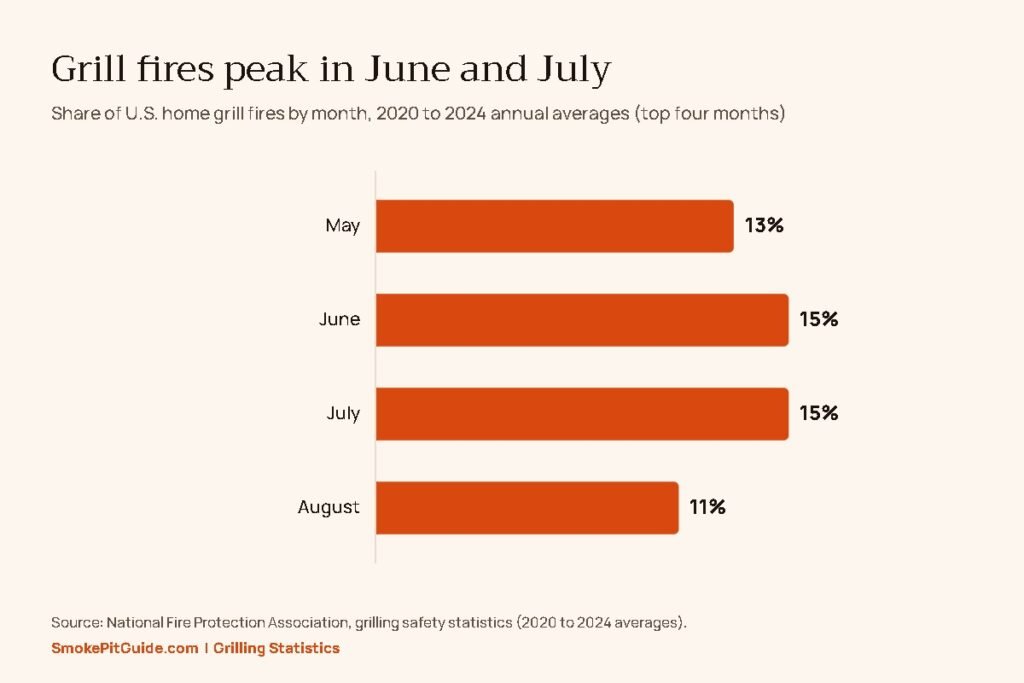
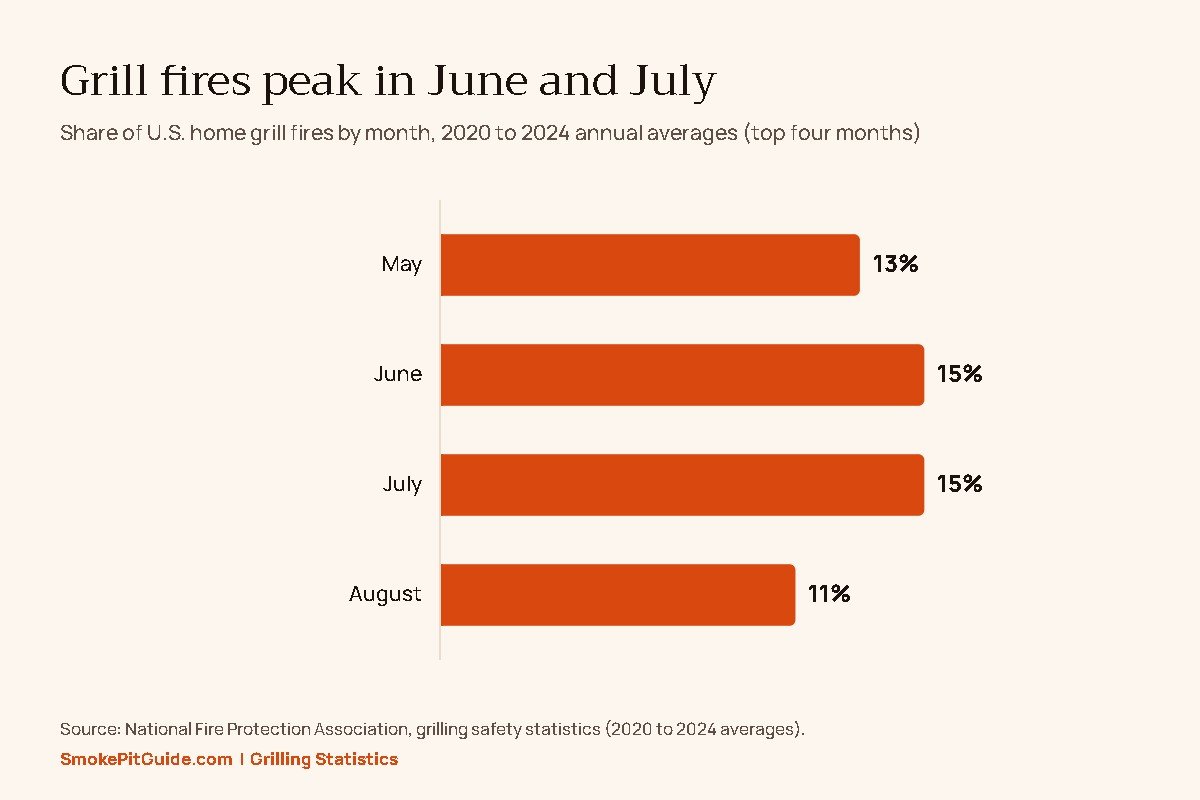
July and June tied as the peak months at 15% each, followed by May at 13% and August at 11%. That's the obvious pattern of more cooking in warm months, and it lines up with the grilling holidays in the owner data further down.
Two details in the NFPA data are more useful than the totals. The grill hadn't been cleaned in roughly one-fifth of the fires, which makes grease buildup one of the few fire causes an owner fully controls. Our guide to cleaning grill grates covers the grates, and the drip tray below them matters just as much. And nearly a quarter of grill structure fires started on an exterior balcony or open porch, which is a strong argument for keeping the grill well away from the house.
Leaks and breaks caused 6% of gas grill structure fires and 13% of outdoor gas grill fires. NFPA's older 2020 report, based on 2014 to 2018 data, found that gas fueled 84% of the grills involved in home fires, against 12% for charcoal or other solid fuel.
Grilling injury statistics
Fires are only part of the grilling injury picture. According to Consumer Product Safety Commission (CPSC) data cited by NFPA, an average of 21,682 people a year went to emergency rooms from 2020 to 2024 with grill-related injuries. That count includes burns and other injuries, not only fires.
Wire grill brush bristles
A smaller but stranger injury comes from wire grill brushes. A bristle breaks off, sticks to the grate, ends up in food, and gets swallowed. A 2016 study in Otolaryngology, Head and Neck Surgery by Baugh, Hadley and Chang used the CPSC's national injury database to estimate about 1,698 emergency room visits from wire bristle injuries between 2002 and 2014.
A 2026 follow-up in the International Journal of Pediatric Otorhinolaryngology by Coppola, Shaffer, and Chi estimated about 3,739 visits from 2015 to 2023 and found cases rising steadily from 2006 onward. The authors note that awareness campaigns haven't reduced the numbers. Most patients were treated and released, about a quarter were admitted, and the throat was the most common injury site.
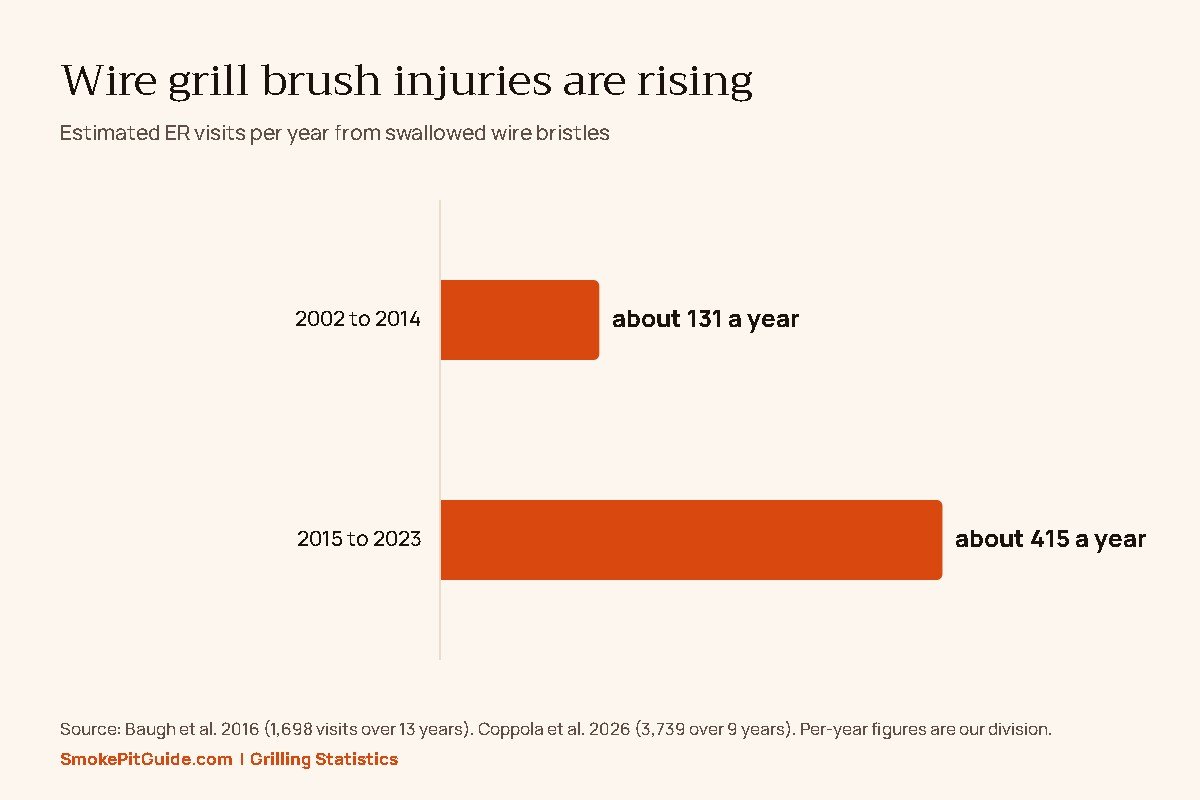
Spread per year, that's roughly 130 visits a year in the first study and about 415 a year in the second. Those per-year figures are our own division of the published totals, and national injury estimates like these come with wide margins, but the direction is clear.
Meat smoking temperature statistics
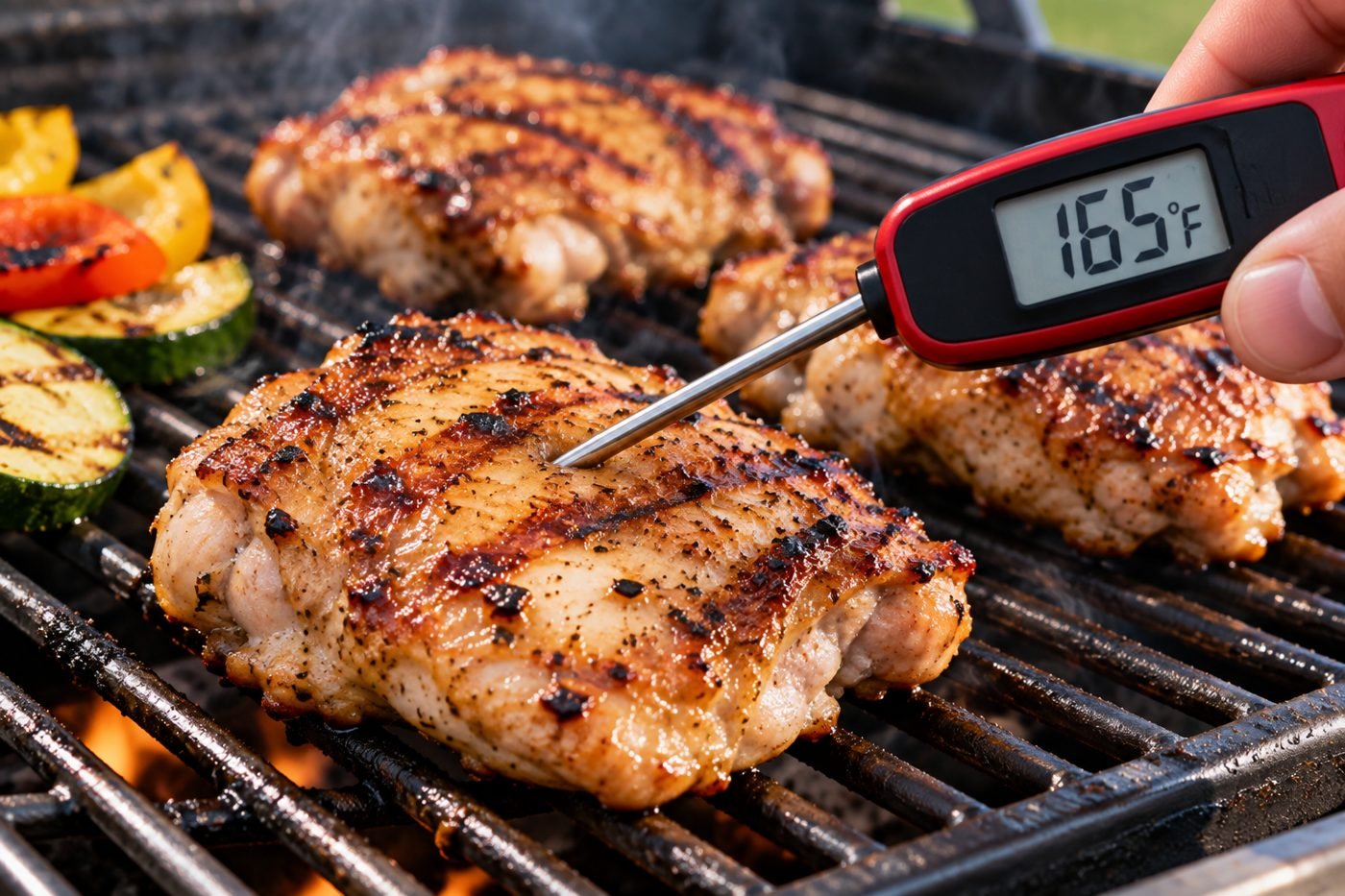
The USDA's Food Safety and Inspection Service sets the safe minimum internal temperatures most smoking guides are built on. Its safe temperature chart says:
For the smoker itself, FSIS's smoking guidance says to keep the air temperature between 225°F and 300°F for the whole cook and to use two thermometers: one for the smoker and one for the meat. If your cooker drifts out of that band, our guide to why a smoker won't hold temperature walks through the usual causes.
These are safety minimums, not doneness targets, and they're the grilling statistics most worth memorizing. A brisket is safe well before it's tender, which is why pitmasters take it much higher, and why the brisket stall is a doneness problem rather than a safety one.
The most telling number in this section is about people, not meat. FSIS says only about 15% of people consistently use a food thermometer, even though it's the only reliable way to know harmful bacteria have been destroyed. A decent instant-read thermometer costs less than one brisket.
Who grills and how often
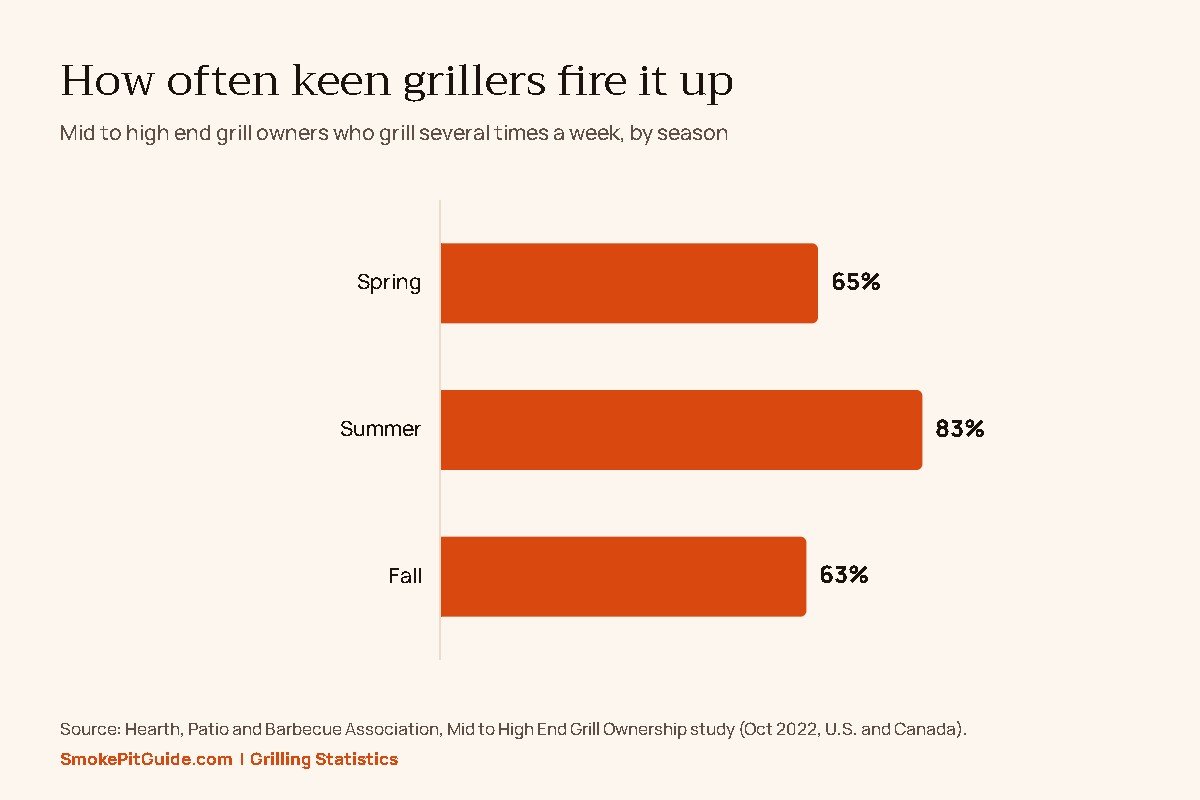
The best recent owner data comes from the Hearth, Patio and Barbecue Association, and it needs one caveat up front. The figures in HPBA's 2025 National Grilling Month release come from its Mid to High End Grill Ownership study, surveyed in October 2022 across the U.S. and Canada. That's people who own mid-range and premium grills, not all grill owners, so treat these as the habits of keen grillers.
Among those owners, 70% grilled on the Fourth of July, the most popular grilling holiday, and 58% grilled on Memorial Day. 83% grilled several times a week in summer, against 65% in spring and 63% in fall. 61% cook on propane and 59% on charcoal or wood, which adds up to more than 100% because plenty of people own both.
35% have an outdoor kitchen, and those who do spent an average of $10,600 on it. 43% cook for groups of ten or more.
Four grilling myths the sources don't support
These come up constantly in grilling articles, forum threads, and backyard advice. Here's what the primary sources say.
Myth 1: Pork has to reach 160°F to be safe
That was the USDA advice until May 24, 2011, when it lowered the safe minimum for whole cuts of pork to 145°F, followed by a 3-minute rest, the same as beef and lamb steaks and roasts. Ground pork is still 160°F. A pork chop cooked to 160°F isn't unsafe, just drier than it needs to be.
Myth 2: Pink smoked meat is undercooked
Color can't tell you whether meat is safe, in either direction. FSIS says appearance and color are not reliable indicators of safety or doneness, and that a food thermometer is the only way to know. Smoked meat that's still pink can be fully safe, and meat that looks well done can still be under temperature. Check it with a thermometer instead of by eye.
Myth 3: Charcoal grills cause most grill fires
It's the other way around. In NFPA's data, gas grills are involved in the large majority of home grill fires, 84% of them in its 2014 to 2018 report, compared with 12% for charcoal and other solid fuels. Gas grills are also far more common, so this doesn't prove any single gas grill is riskier. It does mean the leak check and the grease trap deserve attention.
Myth 4: Grill brush bristle injuries are too rare to worry about
They're uncommon, but not rare enough to ignore, and they're rising. Estimated emergency room visits went from about 1,698 over 2002 to 2014 to about 3,739 over 2015 to 2023, and the 2026 study found that publicity hadn't reduced them. Replacing a worn wire brush, or wiping the grate before cooking, is a cheap fix.
How we checked these grilling statistics
For each figure, we went to the primary source: NFPA's own grilling statistics and research report, USDA FSIS guidance pages, the published injury studies, and HPBA's release. We note the years each number covers and who was surveyed, and we label our own calculations. Where a source's link had broken or redirected, we left that figure out rather than cite something readers can't open.
Last checked: September 28, 2026. We'll update this page when NFPA publishes new grill fire averages, or USDA changes its temperature guidance.
Using these statistics
You're welcome to use any figure or chart on this page in an article, report or presentation. Please link to the primary source for the number and to this page as the place you found it. Suggested citation: SmokePitGuide, "Grilling Statistics: 15 Verified Numbers and 4 Myths," smokepitguide.com/grilling-statistics/, September 2026.
Grilling statistics FAQ
How many grill fires happen each year?
Gas grills alone were involved in an average of 9,235 U.S. home fires a year from 2020 to 2024, according to NFPA. July and June are the peak months.
How many people are hurt by grills each year?
An average of 21,682 people a year went to emergency rooms with grill-related injuries from 2020 to 2024, per Consumer Product Safety Commission data cited by NFPA.
What temperature is pork safe at?
145°F with a 3-minute rest for whole cuts like chops and roasts, per the USDA since 2011. Ground pork is safe at 160°F.
What temperature should a smoker run at?
USDA FSIS recommends keeping the smoker's air temperature between 225°F and 300°F for the whole cook, and checking the meat with a separate food thermometer.
Are wire grill brushes dangerous?
Swallowed wire bristles sent an estimated 3,739 people to emergency rooms from 2015 to 2023, and the numbers have been rising. Inspect the brush, replace it when bristles loosen, and check the grate before cooking.