
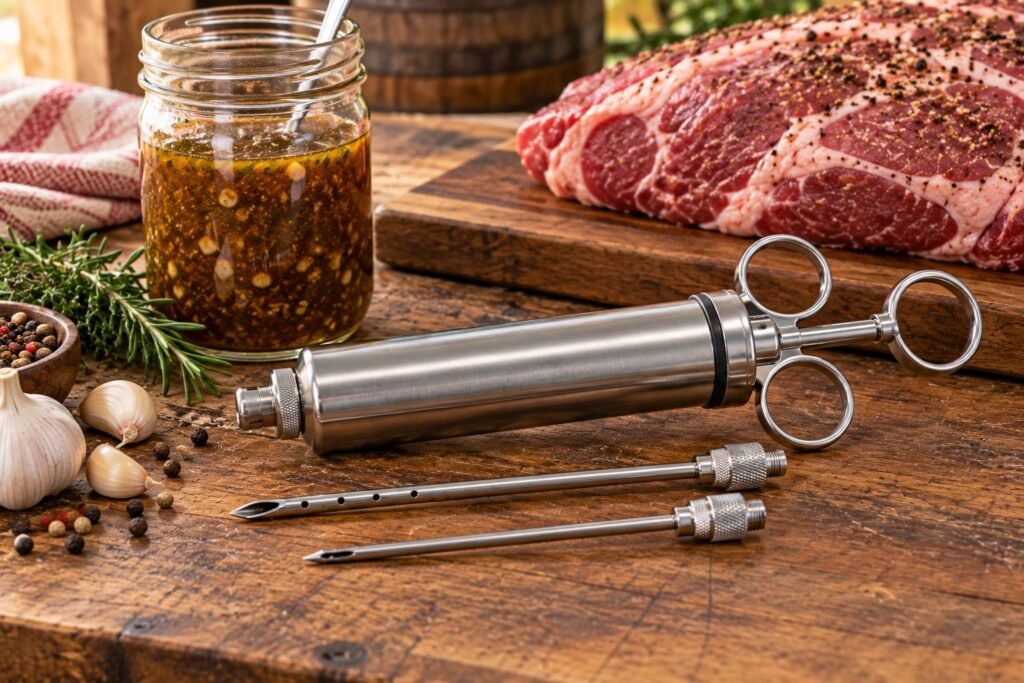
The short answer: if you want one injector that will not clog on you and holds enough marinade to do a full brisket without three refills, the SpitJack Magnum is worth the extra money. If you just want to try injecting for the first time without spending much, the Grill Beast kit does the job for a fraction of the price.
We looked at five: one premium option built for competition teams, and four budget kits that cover almost everyone else's needs. None of them are exotic. Injecting meat is a simple job, and most of these tools do it fine as long as you know what to look for before you buy.
What separates a good injector from a bad one isn't the price tag. It is the needle. A needle that clogs halfway through a brisket, or a plunger seal that lets marinade leak back out around the barrel, ruins the whole point of injecting in the first place. That is where we focused this comparison.
Table of Contents
Comparison: 5 Meat Injectors at a Glance
How We Picked These
We compared listed specs across each brand's own product pages and major retailers (Amazon, Walmart, Home Depot, Tractor Supply) rather than repeating marketing copy. Where a listing did not give an exact number, we say so instead of guessing. We haven't run a side-by-side lab test on all five ourselves, so treat the picks below as a specs-and-reputation comparison, not a hands-on review.
SpitJack Magnum Meat Injector
SpitJack built the Magnum for barbecue competition teams, and it shows. Made in the USA, it comes as a kit with a case, brushes, and a guide. It comes in a 2-needle version (model MJ102) or a 4-needle version (MJ106), depending on how many injection jobs you expect to run in a season. The extra needles are not just a gimmick. Having a spare on hand means you are not stuck mid-cook scrubbing out a clogged one.
This is the injector to buy if you cook competitively or just smoke enough meat that a $15 injector wearing out every year or two annoys you. It costs more than every other pick on this list, and for most backyard cooks that is not worth it. But if you are injecting several briskets or turkeys a month, the SpitJack pays for itself in fewer replacements.
- Made in the USA, stainless construction
- Comes with a case, cleaning brushes, and a printed guide
- 2 or 4 interchangeable needles depending on the kit
- Costs noticeably more than the other options here
Grill Beast Stainless Steel Injector Kit
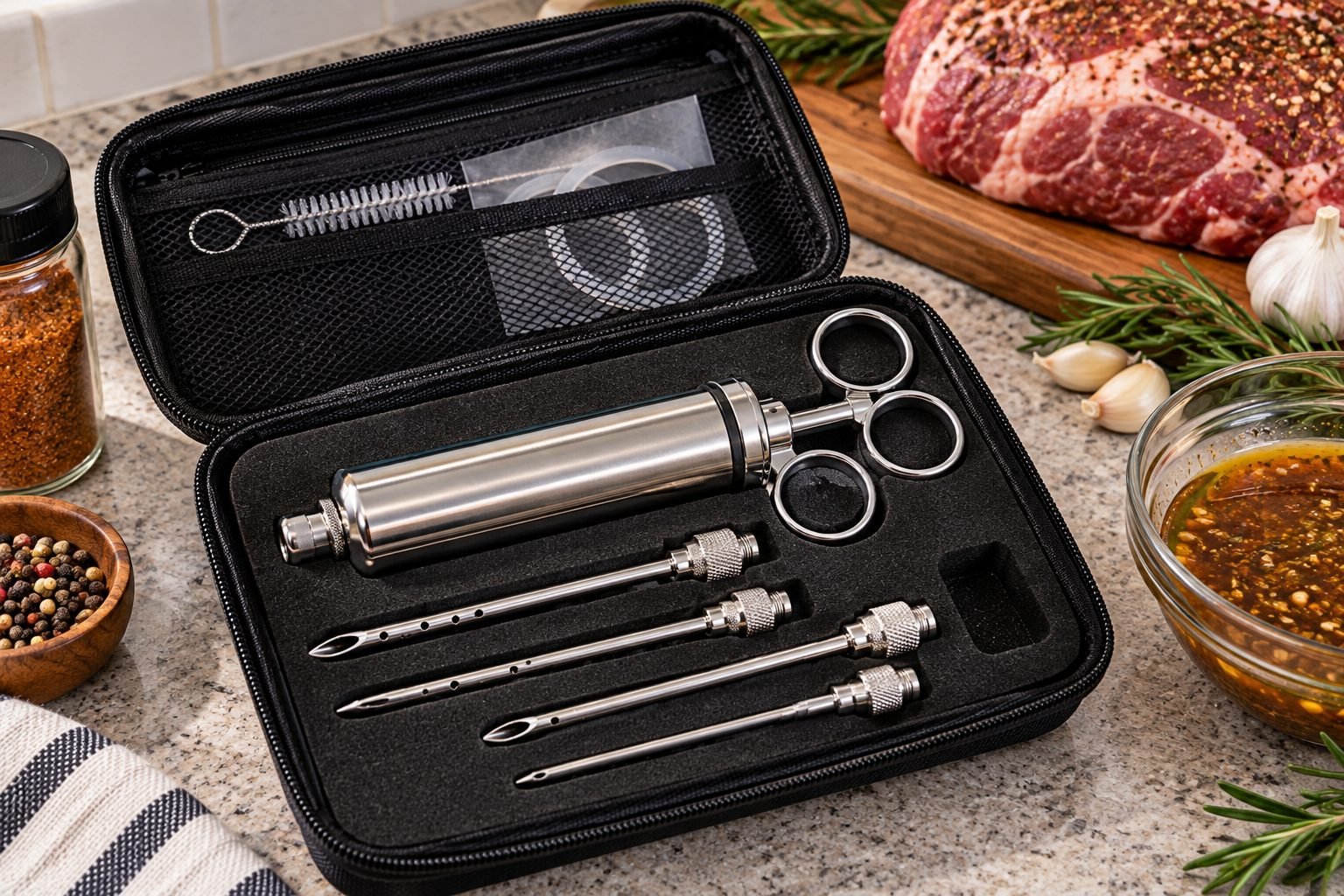
The Grill Beast kit is a 304 stainless steel injector with a 2 oz barrel and three marinade needles in different sizes. It is the pick most people should buy. It is inexpensive, the barrel size is enough for a turkey or pork shoulder without constant refills, and three needle sizes give you options if a thicker marinade with minced garlic or spice keeps clogging the smallest one.
It is not as tough as the SpitJack, but for the price, most backyard cooks will get years of use out of it if they hand-wash and dry it instead of leaving it wet in a drawer.
- 304 stainless steel barrel and needles
- 2 oz capacity, enough for most single roasts without refilling twice
- 3 needle sizes included
- One of the cheapest options here, good value for occasional use
Ofargo Stainless Steel Injector Kit
Ofargo sells a few nearly identical kits under slightly different model numbers, but the common thread is a 2 oz stainless barrel with either 3 or 4 needles and a travel case. It is priced close to the Grill Beast and aimed at the same buyer: someone injecting a few times a year who does not want to spend much to find out if they like doing it.
The plunger on these tends to be plastic rather than stainless, which is the one corner cut compared to the Grill Beast. No one has reported it as a durability issue, but it is worth knowing before you buy if an all-metal build matters to you.
- 2 oz stainless barrel
- 3 or 4 needles depending on the exact kit
- Plastic plunger handle instead of all stainless
- Comes with a travel case
Bayou Classic Stainless Steel Injector
Bayou Classic makes one of the simplest injectors on the market: a 2 oz stainless barrel with two needles, no case, no extras. You can find it at most hardware stores and home improvement chains, which matters if you want one the same afternoon instead of waiting for delivery.
There is nothing wrong with it. It does one job and nothing else. If you want a case, a guide, or a third needle size, look elsewhere on this list.
- 2 oz stainless steel barrel
- 2 needles included
- No case or extras
- Widely stocked in physical stores
Chard Stainless Steel Injector
Chard's injector is another straightforward stainless steel model, most commonly sold in a 2 oz size with two needles, though 1 oz and 4 oz versions exist for smaller or larger jobs. It shows up at Tractor Supply and similar stores alongside other Chard kitchen and canning gear, which is a useful option if you are already picking up smoking supplies somewhere that does not carry the other brands on this list.
- Stainless steel construction
- Sold in 1 oz, 2 oz, and 4 oz sizes
- 2 needles with the standard kit
- Easy to find at farm and hardware stores
Needle Types, and Why They Matter More Than the Brand
Almost every injector clog comes down to one of three things: the marinade is too thick, it has particles in it that are too big for the needle, or the needle opening itself is too small for what you are pushing through it. That is true no matter which brand you buy.
Needles generally come in two styles. An end-opening needle releases liquid straight out the tip, which works well when you want the marinade concentrated at one exact point. A side-opening needle has holes along the shaft instead, so it spreads liquid along the path as you slowly pull it back out of the meat. Most multi-needle kits include both, and it is worth using the right one instead of grabbing whichever needle is on top.
If you plan to inject a thin liquid like broth or a strained brine, a smaller needle opening is fine. If your marinade has minced garlic, cracked pepper, or anything with texture, strain it first or use a needle with a wider opening. Buying a fancier injector will not fix a marinade that is too chunky for any needle to handle.
How to Inject Meat Without Making a Mess
Strain your marinade through a fine-mesh strainer before it gets near the injector. This single step prevents most clogs.
Draw the plunger back slowly so you do not pull in air bubbles, then push the needle fully into the thickest part of the meat before you start injecting. Withdraw the needle slowly while pressing the plunger at a steady, even pace instead of one quick push. This spreads the marinade along the needle's path rather than pooling it all in one spot, where it just squirts back out through the entry hole.
Work in a grid pattern across the cut, injecting every inch or two, and expect some liquid to leak out around the injection points. That is normal. Pat the surface dry with a paper towel afterward if you are about to apply a dry rub, since a wet surface keeps the rub from sticking the way it should.
Food Safety When Injecting Meat
Injecting pushes marinade past the surface of the meat, which changes a couple of food safety rules compared to just brushing a marinade on top. Keep the meat refrigerated while it sits with the injected marinade, the same as you would with any raw meat. Sitting it out at room temperature lets it drift into the temperature range where bacteria multiply fastest.
If you want to use extra marinade as a mop sauce or finishing liquid later, set some aside before it ever touches raw meat. Marinade that has been in contact with raw meat should be thrown out or brought to a full rolling boil for at least a minute before it touches anything else. That is what kills any bacteria the raw meat introduced.
Wash your injector in hot, soapy water after every use, and take the needle apart if it comes apart, since dried marinade inside a needle is exactly the kind of thing that causes a clog on your next cook.
Is a meat injector worth it?
For big, dense cuts like brisket, pork shoulder, or a whole turkey, yes. A rub and a spritz only season the outside. An injector gets flavor and moisture into the middle of the meat, which matters more the bigger the cut is. For a thin cut like a chicken breast or steak, a marinade soak works about as well without the extra tool.
How much marinade should I inject into a brisket?
Most home cooks use somewhere around 1 to 2 ounces of marinade per pound of meat, injected in a grid pattern across the flat and the point. A 2 oz barrel injector will need a few refills on a full-size brisket, which is normal.
Can I inject meat the night before I cook it?
Yes, and it often helps the flavor spread further into the meat. Keep it covered and refrigerated the whole time, the same as you would with any raw meat that is marinating.
Why does my meat injector keep clogging?
Almost always because the liquid is too thick, has bits of garlic, herbs, or spice in it, or is being forced through a needle opening that is too small. Strain the marinade through a fine mesh strainer first, and use a needle with a wider or side-opening design for anything with texture.
Is it safe to reuse leftover injection marinade as a sauce?
Not directly. Marinade that touched raw meat needs to be brought to a full boil for at least a minute before you use it as a sauce or mop (a thin basting sauce). Or just set aside a separate portion before it ever touches the raw meat in the first place.
If you are prepping a brisket this weekend, pairing an injector with the right wood matters just as much as the tool itself. Our guide to the best wood for smoking brisket covers which woods hold up over a long cook and which ones to skip.