
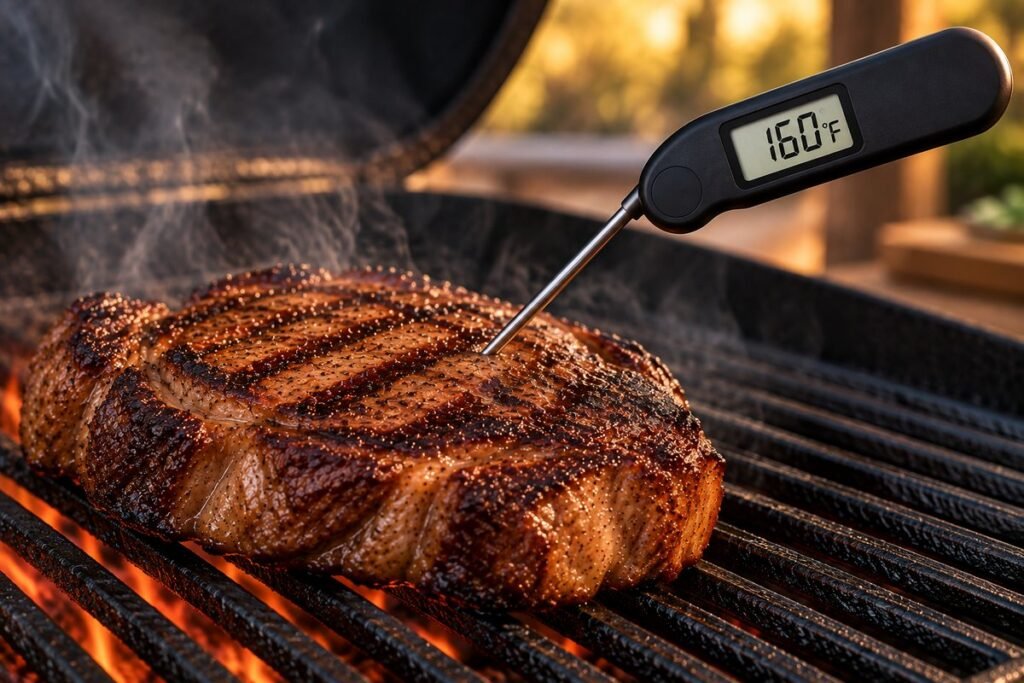
A good steak dinner has been ruined by a bad guess more times than anyone wants to admit. The single tool that ends the guessing is a meat thermometer. After comparing specs, accuracy claims, and owner feedback across the current lineup, a handful of models stand out.
This guide covers the best meat thermometer for nearly every situation, from a $13 instant-read for weeknight chicken to a wireless dual-probe rig built for an all-day brisket smoke.
Below you'll find six picks worth buying, a full buying guide, and a quick-reference safe-temperature chart. Every recommendation is based on published manufacturer specifications, independent lab-style accuracy claims, and a cross-check of verified owner reviews, not a single unboxing video.
If you take away one rule, it's this: check the stated accuracy rating before anything else.
Table of Contents
Our Top Picks at a Glance
If you're short on time, here's the fast version: a quick snapshot of each pick. We cover each pick in full detail further down the page.
| Thermometer | Best For | Type | Approx. Price |
|---|---|---|---|
| ThermoWorks Thermapen ONE | Best overall | Instant-read | ~$105 |
| MEATER Pro Duo | Best wireless smart probe | Wire-free, Bluetooth + WiFi | ~$149 |
| ThermoPro TP19H | Best budget pick | Instant-read | ~$15-20 |
| ThermoPro TP20 | Best for smokers (long range) | Wired dual-probe, RF remote | ~$60 |
| Inkbird IBBQ-4T | Best multi-probe for big cooks | 4-probe, WiFi + app | ~$55-65 |
| Typhur Sync Gold Dual | Best splurge | Wire-free dual-probe, WiFi + Bluetooth | ~$150 |
How We Picked These Thermometers
SmokePitGuide is a new site, and we'd rather say that plainly than pretend otherwise. These picks come from comparing published accuracy specs (most brands now state a plus-or-minus figure, which is the number that matters), response-time claims, probe count and range, and a wide read of verified owner reviews on retailer and manufacturer sites.
When two products were close, we favored the one with a longer track record and a manufacturer that backs its accuracy claim with a stated tolerance rather than marketing language alone.
We also weighted real-world usability over spec-sheet bragging rights. A thermometer with slightly wider accuracy but a display you can read in direct sun, or an app that doesn't drop connection mid-cook, wins more kitchens than a marginally tighter tolerance nobody notices in practice.
Finally, we looked for spread across use cases rather than six versions of the same product. A single household might reasonably own two of these, a fast instant-read for weeknight cooking and a wireless probe for weekend smokes. The list below is built to cover that range rather than crown one all-purpose winner and stop there.
Best Overall: ThermoWorks Thermapen ONE
The Thermapen ONE is the instant-read thermometer most working cooks and serious home grillers reach for first, and it earns that reputation. ThermoWorks rates it at roughly one second to a stable reading, with accuracy within plus or minus 0.5°F, backed by a calibration certificate traceable to National Institute of Standards and Technology (NIST) standards.
The auto-rotating display, backlight, and motion-sensing sleep mode are the kind of small details that matter every time you use it, not just on the spec sheet.
- 1-second average response time
- ±0.5°F accuracy, NIST-traceable
- IP67 water-resistant, antimicrobial casing
- Auto-rotating, backlit display
The catch is price. At around $105, it costs roughly five times as much as a perfectly usable budget instant-read. If you cook meat often enough that speed and accuracy pay for themselves in better results, it's worth it. If you're grilling burgers twice a summer, skip to the budget pick below.
It pays off in the moments that matter most: pulling a ribeye off a screaming-hot cast-iron pan for a two-second temp check without losing the sear, or double-checking the thickest part of a spatchcocked (flattened) chicken thigh right before it comes off the grill.
A one-second read means the probe is in and out before much heat escapes, which is a clear advantage over slower instant-reads on quick-cooking cuts.
See current specs on the ThermoWorks product page.
Best Wireless Smart Probe: MEATER Pro Duo
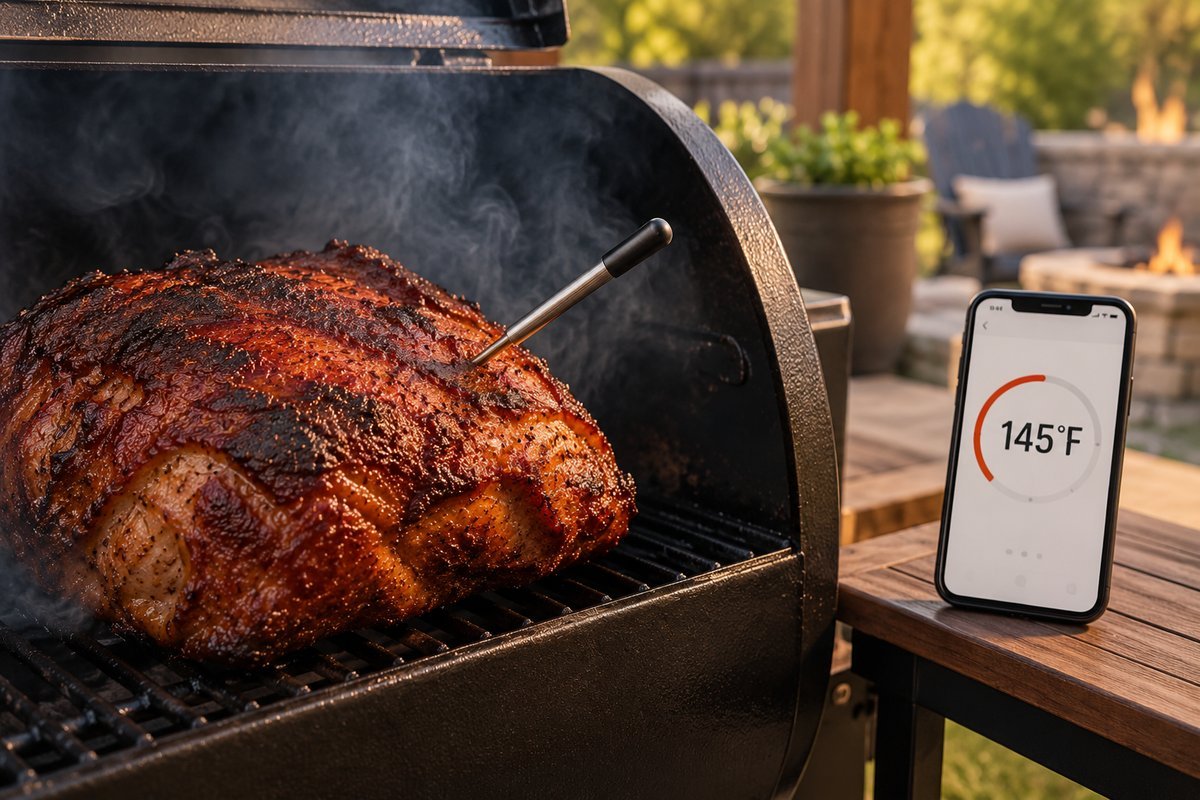
MEATER's wire-free design is the reason it became the default answer for "best wireless meat thermometer" searches. No cable runs out of your smoker's lid, and the app graphs your cook in real time.
The Pro Duo steps up from the original single-probe MEATER with dual sensors per probe (internal meat temp plus ambient/grill temp), a claimed ±0.5°F accuracy, and a 1,000°F ambient rating that survives sitting directly on a grill grate.
- 100% wire-free, dual internal + ambient (air inside the smoker) sensors per probe
- Bluetooth 5.2 with WiFi relay through the charging block
- 1,000°F ambient temperature rating
- IP68 waterproof, dishwasher-safe probes
The tradeoff versus a wired remote thermometer is range and reliability in the exact conditions that matter for smoking: thick smoker walls and long distances can still interrupt Bluetooth, even with the WiFi relay.
For a covered patio grill or a smoker parked near the house, it's close to ideal. For a stick burner way out in the yard, a wired RF remote like the ThermoPro TP20 below is the safer bet.
The app's estimated finish time is the feature owners mention most. It recalculates as the cook progresses, so you get a realistic window for when a low-and-slow pork shoulder or a reverse-seared roast will hit target temperature instead of a static guess made at the start.
See current specs on the MEATER product page.
Best Budget Pick: ThermoPro TP19H
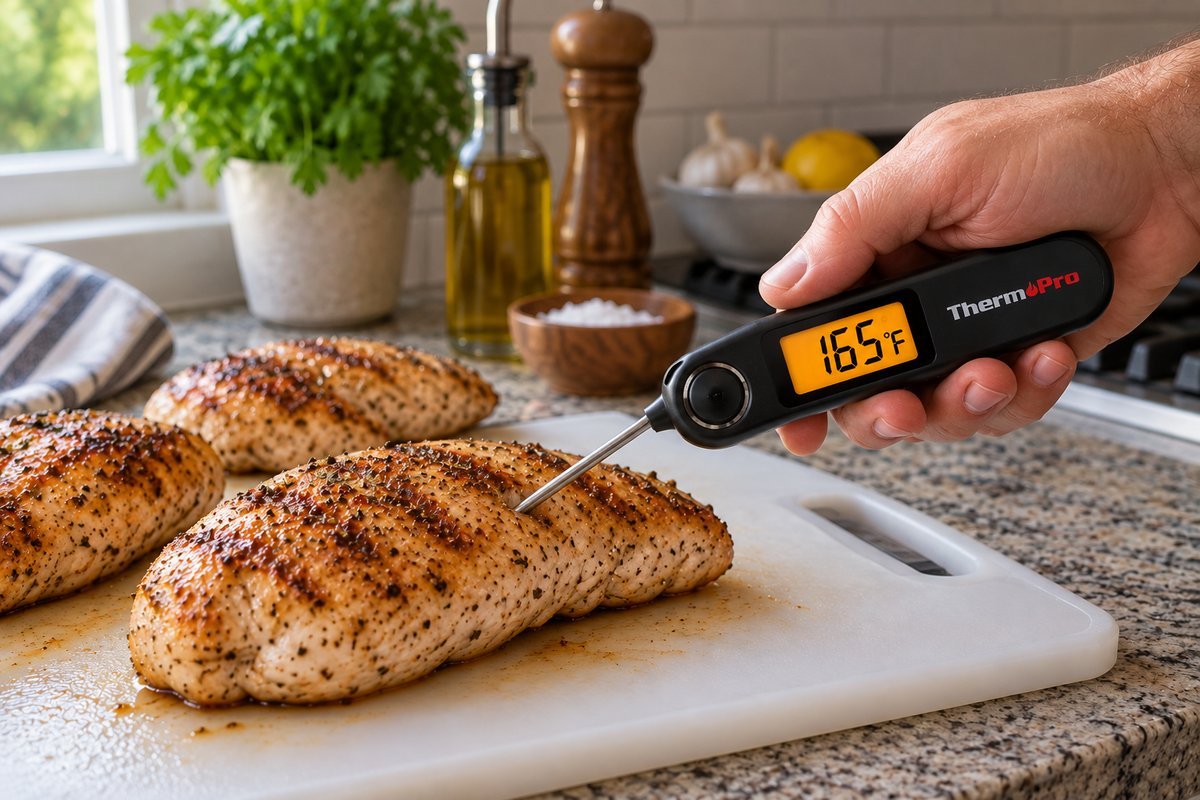
Not everyone needs NIST-traceable calibration to grill a chicken breast. The TP19H is a straightforward instant-read that regularly sells in the $15 to $20 range, and it covers the fundamentals well: a large backlit display, motion-sensing wake, a foldable probe, and a splash-proof (not fully waterproof) body.
It won't match the Thermapen ONE's read speed or tolerance, but for the price of a couple of beers, it turns "guess and cut into it" into "check and know."
- Ambidextrous, foldable probe design
- Large backlit, motion-sensing display
- Splash-proof housing
- Wide temperature range covers meat, candy, and oil
This is the thermometer to buy if you're outfitting a first kitchen, replacing a lost one before a weekend cookout, or just want a reliable backup to keep in the truck alongside a "real" one.
Plenty of experienced grillers keep one of these in a drawer even after buying something nicer, simply because it's cheap enough not to worry about losing.
Best for Smokers (Long-Range Remote): ThermoPro TP20
Long smokes are a different problem than a quick sear. You need to monitor both the meat and the pit temperature for hours without opening the lid, and you need a signal that doesn't drop out.
The TP20 uses a dedicated radio frequency (RF) receiver rather than Bluetooth or WiFi, which means no app, no pairing, and a claimed range up to roughly 300 feet. That is more than enough to walk back inside the house and still see both readings.
- Dual probes: one for meat, one for pit/ambient temperature
- Dedicated handheld receiver, no app required
- Claimed range up to ~300 feet
- Runs on AAA batteries, no charging cradle to remember
The display and accuracy won't win a spec-sheet contest against a smart probe, and the wired probes mean you're managing two cables running out from under the lid.
But for a set-it-and-forget-it overnight brisket, a dedicated RF remote is still the most dependable thermometer category there is. There's no app to lose connection, no Bluetooth handshake to fail at 3 a.m., just a receiver that either shows a number or doesn't.
Best Multi-Probe for Big Cooks: Inkbird IBBQ-4T
Smoking a whole packer brisket, a couple of racks of ribs, and a pork butt at once means you need more than two probes. The IBBQ-4T runs four color-coded probes off one rechargeable base station, with WiFi connectivity through Inkbird's app for temperature graphs and high/low alarms you can check from another room or another building.
- 4 probes, color-coded for easy identification
- Rechargeable base, magnetic mount
- WiFi app with graphing and custom alarms
- Temperature range covers both meat and ambient/pit monitoring
Four probes at this price point is the whole appeal. You're trading some of the polish and accuracy tolerance of the premium picks for useful capacity when the smoker is full.
For anyone hosting a big cookout where the pit is loaded with multiple cuts finishing at different times, seeing all four temperatures on one screen beats juggling several single-probe units.
See current specs on the Inkbird product page.
Best Splurge: Typhur Sync Gold Dual
If budget isn't the constraint, Typhur's Sync line pushes wire-free probe technology further than most competitors. The Sync Gold Dual pairs two fully wireless probes with WiFi and Bluetooth connectivity for redundancy. It claims ±0.5°F accuracy, and includes a standalone base station with its own display, so you don't need to keep your phone within range to check the temperature.
- 2 wire-free probes, multi-sensor design
- WiFi + Bluetooth dual connectivity for a more stable signal
- Standalone base station with its own LCD display
- ±0.5°F claimed accuracy
At around $150, it sits in the same price bracket as buying two separate quality thermometers. For someone who cooks often enough to want one system that does everything well, it's a reasonable one-and-done buy.
Running WiFi and Bluetooth together is a practical advantage over single-connectivity smart probes, since the base station can hand off to whichever signal is stronger instead of dropping the connection entirely.
Also Worth Considering
The six picks above cover most kitchens, but a few more models are worth knowing about depending on your specific setup.
Lavatools Javelin PRO Duo is a close alternative to the ThermoPro TP19H in the budget instant-read category, usually costing a few dollars more for a faster claimed response time and a slightly larger, easier-to-read display. If the TP19H is out of stock, this is the first place to look.
ThermoWorks Smoke X4 sits above the ThermoPro TP20 as a premium four-probe RF remote, aimed at competition-style cooks who want ThermoWorks' accuracy and build quality without switching to a wire-free system.
It costs several times more than the TP20, so it only makes sense if you're already committed to the ThermoWorks ecosystem or specifically need the extra probe count in a wired system.
ThermoPro TP826 is worth a look if you want a dedicated wired remote thermometer with more probe flexibility than the TP20. It's available in two- or four-probe configurations and, like the TP20, skips the app entirely in favor of a handheld receiver.
Caring for Your Meat Thermometer
A little maintenance keeps any of these accurate for years, not months. Wipe probes clean after every use rather than letting marinade or grease dry on the sensor tip. Buildup there is one of the most common causes of a thermometer reading slowly or drifting off over time.
Even IP67-rated units generally aren't meant for a full dishwasher cycle unless the manufacturer says otherwise. A warm rinse and a towel-dry is the safer habit.
It's worth checking calibration once or twice a season, especially on a thermometer that gets dropped or left in a hot smoker regularly. The simplest test requires no special equipment: an ice-water bath should read 32°F, and a gentle boil at sea level should read 212°F.
A reading more than a couple of degrees off in either test is a sign the unit needs recalibrating or, on wireless probes without a calibration adjustment, replacing.
A five-minute calibration check twice a season keeps any thermometer reading accurately for years.
How to Choose the Best Meat Thermometer
The right choice depends far more on how you cook than on which thermometer has the flashiest spec sheet. Work through these five questions before buying.
Instant-Read vs. Leave-In vs. Wireless
An instant-read thermometer is for spot-checking. You insert it, get a reading in a few seconds, and pull it back out. It's the right tool for steaks, chicken breasts, and anything cooked quickly and checked near the end.
A leave-in or wireless probe stays in the meat for the entire cook, which is what you want for a roast, a whole turkey, or anything on a smoker for hours. Buying only an instant-read for a long smoke means opening the lid repeatedly to check, which loses heat and adds cook time each time.
Accuracy Rating
Look for a stated plus-or-minus figure, not just the word "accurate" on the packaging. Anything at ±1°F or tighter is good. ±2°F is still usable for most home cooking but leaves less margin near food-safety thresholds.
Probe Count and Range
One probe is fine for a single cut. If you're smoking multiple items, or want to track both meat and pit temperature at once, you need at least two probes. And if you plan to walk away from the smoker, check the stated wireless range rather than assuming.
Ambient Temperature Rating
A probe rated only for internal meat temperature can be damaged if you leave it resting directly on a hot grill grate or inside a smoker running above its rating. If you plan to leave a probe in place on the grate itself rather than just inside the meat, check the ambient rating specifically. It's usually listed separately from the meat-reading accuracy spec.
Water Resistance
An IP67 or better rating means the unit can handle a full rinse or an accidental dunk. That matters more than it sounds like it should: thermometers get set down in marinade, dropped in a sink, and left out in the rain more often than any of us plan for.
How to Use a Meat Thermometer Correctly
Insert the probe into the thickest part of the cut, away from bone, fat pockets, and, on a whole bird, away from the cavity. Bone conducts heat differently than muscle and will throw off the reading. Fat pockets read cooler than the surrounding meat.
For thin cuts like burger patties or chicken breasts, insert from the side rather than the top so the tip sits at the true center.
U.S. Department of Agriculture (USDA) minimum safe internal temperatures are a fixed reference point worth keeping handy, regardless of which thermometer you're using:
| Food | Minimum Safe Internal Temp |
|---|---|
| Poultry (whole, parts, ground) | 165°F |
| Ground beef, pork, lamb, veal | 160°F |
| Beef, pork, lamb, veal (steaks, chops, roasts) | 145°F, plus a 3-minute rest |
| Fish and shellfish | 145°F |
These are minimums, not targets. Plenty of cooks pull steak and chops earlier for a different level of doneness and let carryover cooking (the temperature keeps rising after you pull the meat) finish the job during the rest. For the full breakdown by food type, see the USDA's safe minimum internal temperature chart.
If you're troubleshooting a smoker that won't hold a steady pit temperature while your probe says something's off, our How-Tos & Fixes section covers the most common causes.
If a wireless, walk-away setup matters most, see our dedicated best wireless meat thermometers ranking.
Frequently Asked Questions
Do I need an expensive meat thermometer?
No. An inexpensive instant-read thermometer like the ThermoPro TP19H is accurate enough for the vast majority of home cooking. The higher-priced options justify their price through speed, tighter accuracy tolerances, and wireless convenience, not through giving you a fundamentally different reading.
What's the difference between an instant-read and a leave-in probe thermometer?
An instant-read is meant to be inserted briefly to spot-check a temperature and then removed. A leave-in or wireless probe thermometer stays in the meat for the full cook, which is the better choice for anything on a smoker or in the oven for an extended time.
How accurate should a meat thermometer be?
Look for a stated accuracy of plus-or-minus 1.8°F or tighter. Premium instant-read models like the Thermapen ONE claim plus-or-minus 0.5°F, which matters most when you're cooking close to a specific doneness target rather than a wide safety margin.
Where should I insert a meat thermometer probe?
Into the thickest part of the cut, avoiding bone and large fat pockets, both of which read differently than the surrounding muscle. For thin cuts, insert from the side so the tip sits at the true center of the meat rather than near a surface.
Do wireless meat thermometers work through a smoker's metal walls?
Signal strength drops noticeably through heavy metal smoker walls, which is why dedicated RF remote thermometers like the ThermoPro TP20 typically outperform Bluetooth-based smart probes for long, unattended smokes. WiFi-relay models help close that gap but still perform best at shorter range.
Final Verdict
For most people, the best meat thermometer to buy is the one that matches how often you cook and what you cook most. The ThermoWorks Thermapen ONE is our overall pick for its speed and accuracy in one pocket-sized tool.
If you're smoking low and slow, a wireless or long-range remote probe (the MEATER Pro Duo, ThermoPro TP20, or Inkbird IBBQ-4T, depending on your setup) will do more for your results than any single instant-read ever could. And if you just need something reliable for weeknight cooking, the $15 ThermoPro TP19H covers it.
Whichever one you pick, the bigger upgrade isn't the thermometer itself. It's no longer guessing. For more gear picks, see our Smokers & Grills and Accessories guides.